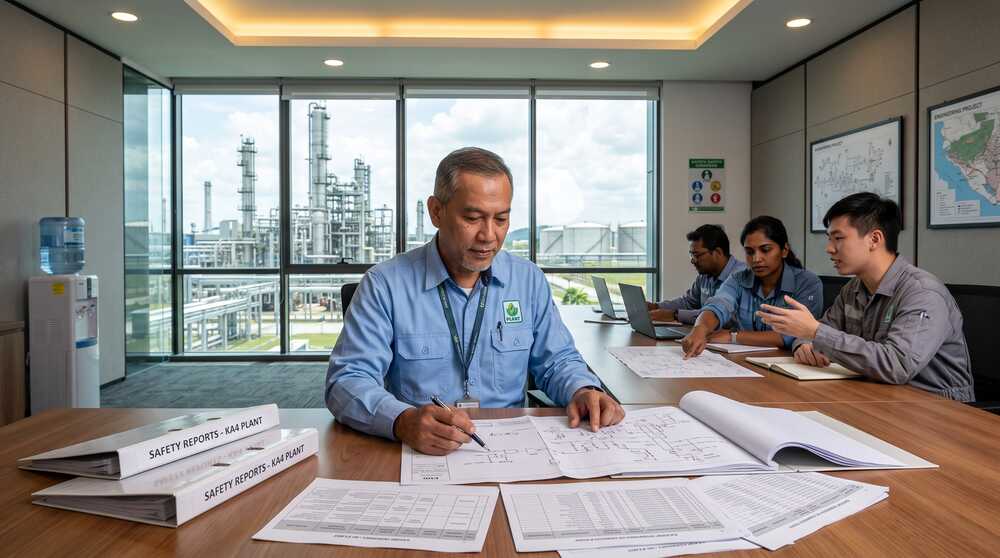
- What: An independent safety review is a systematic, third-party evaluation of a facility’s safety systems, procedures, and design against regulatory requirements and industry best practices conducted by qualified professionals who are independent from the project team.
- Why: Independent safety reviews catch blind spots that internal teams miss. When you design, build, and operate a facility, familiarity bias can obscure safety gaps that an independent reviewer identifies immediately.
- Problem: Many Malaysian industrial facilities proceed through design, construction, and commissioning phases without an independent safety review, discovering safety deficiencies only after incidents occur or during regulatory audits.
- Solution: A structured independent safety review programme conducted at key project milestones and periodically during operations provides assurance that safety barriers are adequate, complete, and properly implemented.
- Next Step: Engage an independent process safety consultancy to conduct a safety review of your facility before commissioning, after modifications, or as part of a periodic safety assessment cycle.
What is an Independent Safety Review?
An independent safety review is a comprehensive evaluation of an industrial facility’s safety arrangements covering design, engineering, procedures, safety systems, and operational practices carried out by qualified professionals who have no direct involvement in the project or facility being reviewed. The independence of the reviewer is the defining characteristic: it ensures objectivity, eliminates conflicts of interest, and provides genuine assurance rather than self-certification.
The scope of an independent safety review typically includes process hazard analysis completeness and quality, safety instrumented system design and SIL compliance, emergency response plan adequacy, mechanical integrity programme evaluation, management of change procedures, operating and maintenance procedures, training programme effectiveness, compliance with applicable codes, standards, and regulations, and the overall effectiveness of the facility’s process safety management framework.
Independent safety reviews can be triggered at several points in a facility’s lifecycle: during Front-End Engineering Design (FEED), before construction completion and commissioning (pre-startup safety review or PSSR), at defined intervals during operations (typically every 3 to 5 years), after significant modifications or expansions, following a major incident or near-miss, and when regulatory requirements mandate independent assessment.
The concept is rooted in the principle that self-assessment has inherent limitations. No matter how competent your internal team, the people who designed and built a system are the least likely to identify its weaknesses. An independent safety review brings fresh eyes, diverse experience, and freedom from organisational pressures that might otherwise compromise the thoroughness of the assessment.
Malaysian Data & Regulatory Context
In Malaysia, the requirement for independent safety review is embedded in multiple regulatory and industry frameworks. The Occupational Safety and Health Act 1994 places a general duty on employers to ensure the safety and health of workers which in practice requires systematic safety assessments by competent persons. The Control of Industrial Major Accident Hazards (CIMAH) Regulations 1996 specifically require facilities handling major accident hazard substances to prepare safety reports that include comprehensive risk assessments.
PETRONAS Technical Standards mandate independent safety reviews for oil and gas facilities at key lifecycle stages. The Mandatory Control Framework includes requirements for process hazard analysis, functional safety assessment, and pre-startup safety reviews that must be conducted or verified by independent competent persons.
DOSH reported over 10,000 workplace inspections in 2021, though only 24% led to follow-up actions or improvement orders. This statistic documented in a review published by the International Journal of Research and Innovation in Social Science (2025) highlights a gap between inspection activity and safety outcome improvement that independent safety reviews can help address.
Malaysia ratified the ILO Occupational Safety and Health Convention (No. 155) in 2024, signalling a national commitment to strengthening safety management systems. The upcoming OSH Master Plan 2026–2030, currently in development with ILO technical support, is expected to further reinforce the role of independent safety assessment in Malaysia’s industrial safety framework.
For plant managers and project directors, the regulatory trajectory is clear: independent safety reviews are moving from best practice to mandatory requirement across Malaysia’s industrial sectors.
How an Independent Safety Review Works

An effective independent safety review follows a structured methodology:
Phase 1: Scoping & Planning The review team defines the scope, objectives, and criteria for the assessment. This includes identifying the applicable regulatory requirements, industry standards, and company-specific safety standards. A detailed review plan is developed, specifying the areas to be assessed, the documentation to be reviewed, and the schedule for site visits and interviews.
Phase 2: Documentation Review The review team examines safety-critical documentation including HAZOP study reports and action closure records, SIL assessment and verification records, P&IDs and design basis documents, operating and maintenance procedures, emergency response plans, training records, incident and near-miss investigation reports, management of change records, and mechanical integrity programme documentation.
Phase 3: Site Walkdown & Verification A physical walkdown of the facility verifies that the as-built condition matches the design documentation, that safety devices are installed and accessible, that safety signage and emergency equipment are in place, and that general housekeeping and maintenance standards are adequate. The walkdown also provides an opportunity to observe actual work practices and compare them with documented procedures.
Phase 4: Interviews & Competency Assessment The review team interviews operations, maintenance, and safety personnel to assess their understanding of process hazards, emergency procedures, and their specific safety responsibilities. This phase often reveals gaps between documented procedures and actual practices.
Phase 5: Findings, Risk Ranking & Recommendations All findings are documented, risk-ranked based on severity and likelihood, and presented with specific, actionable recommendations. Critical findings that represent immediate safety risks are communicated to management without delay.
Phase 6: Reporting & Action Tracking A comprehensive review report is issued, and a structured action tracking system is established to monitor the closure of recommendations. Follow-up verification is conducted to confirm that corrective actions have been implemented effectively.
Risk Factors
Complacency in Established Operations: Facilities that have operated without incidents for many years may develop a false sense of security. An independent safety review often reveals that safety margins have been gradually eroded through accumulated small changes each individually insignificant but collectively creating significant risk.
Inadequate Pre-Startup Safety Reviews: PSSR is a critical checkpoint before any new or modified facility is placed into service. Facilities that rush through PSSR or treat it as a formality risk commissioning equipment with unresolved safety deficiencies.
Change Accumulation: Multiple management of change approvals over years can transform a facility’s risk profile without any single change triggering a comprehensive safety reassessment. Independent safety reviews provide the periodic “reset” that catches accumulated drift.
Competency Gaps: As experienced personnel retire and are replaced by less experienced staff, institutional knowledge of safety-critical decisions, design basis assumptions, and historical incidents can be lost. Independent safety reviews help verify that current personnel understand the safety context of their facility.
Regulatory Non-Compliance: Malaysia’s regulatory landscape is evolving rapidly. The SSI Regulations 2025, CIMAH requirements, and PETRONAS Technical Standards create a complex compliance environment. DOSH guidelines suggested that independent review helps ensure compliance across all applicable frameworks.
Industry Myths vs. Reality
| Myth | Reality |
|---|---|
| “Our internal safety team can do the review they know the plant best.” | Knowledge of the plant is valuable, but independence is essential. Internal teams have inherent biases and organisational pressures that compromise objectivity. An independent reviewer brings fresh perspective. |
| “We just had a HAZOP we don’t need a safety review.” | HAZOP is one component of safety assessment. An independent safety review evaluates the entire safety management system, including whether HAZOP recommendations have been implemented and whether operating practices match design assumptions. |
| “Independent safety reviews are only for major hazard installations.” | Any facility operating processes with significant safety risks benefits from periodic independent review. The scale and depth of the review can be proportionate to the facility’s complexity and hazard profile. |
| “Safety reviews slow down projects and increase costs.” | Identifying safety gaps during design or pre-commissioning is orders of magnitude cheaper than discovering them through incidents. The cost of an independent review is negligible compared to the cost of a major accident. |
| “We passed the DOSH inspection, so our safety systems are adequate.” | DOSH inspections verify compliance with specific regulatory requirements at a point in time. An independent safety review provides a comprehensive, in-depth assessment of the overall safety management system. |
Our Experience at Pure Integrity
Facing Industry Challenges
In our project experience across Malaysian facilities, we have seen how the absence of independent safety reviews leads to accumulated safety gaps. Facilities that rely solely on internal assessment often discover too late that critical HAZOP recommendations were not closed, that SIS designs were not verified against current operating conditions, or that emergency response plans were outdated.
We have conducted independent safety reviews for offshore platforms where design basis assumptions no longer matched current production profiles, for onshore chemical plants where multiple modifications had collectively changed the facility’s risk profile, and for new facilities where pre-startup safety reviews revealed installation deficiencies that would have caused operational problems.
Solving Safety Review Challenges
At Pure Integrity, our independent safety review approach combines process safety expertise with practical field experience. Our team includes TÜV-certified Functional Safety Engineers, experienced HAZOP facilitators, and process safety professionals who understand both Malaysian regulatory requirements and international best practices.
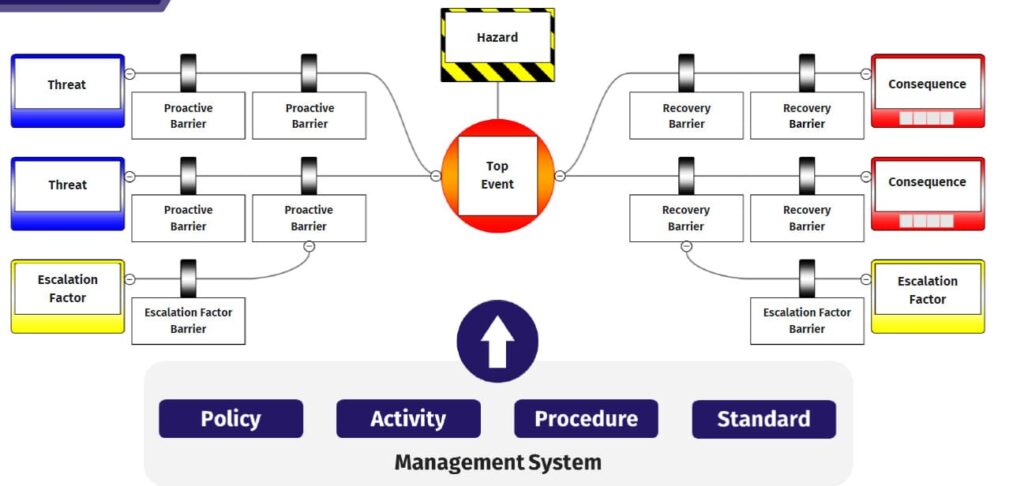
Our review methodology covers all elements of PSM, with particular focus on the areas where gaps most commonly occur: HAZOP/HAZID study quality and recommendation closure, functional safety system design and verification, BowTie analysis and major hazard management, and ALARP assessment compliance.
Our Procedure for Independent Safety Review
Step 1: Scoping Workshop We work with your management team to define the review scope, objectives, and applicable standards.
Step 2: Documentation Request & Review We compile and systematically review all safety-critical documentation against regulatory and industry requirements.
Step 3: Site Walkdown Our team conducts a detailed facility walkdown to verify as-built conditions against design documentation and assess physical safety arrangements.
Step 4: Personnel Interviews We interview operations, maintenance, and safety personnel to assess competency, awareness, and the alignment of actual practices with documented procedures.
Step 5: Gap Analysis & Risk Ranking We identify all findings, rank them by risk severity, and develop specific, actionable recommendations for each.
Step 6: Report & Action Tracking We deliver a comprehensive review report and support implementation tracking to ensure recommendations are closed effectively.
Expert Commentary

An independent safety review is not a criticism of your team it is a complement to their work. The best-run facilities in the world use independent reviewers precisely because they recognise the limitations of self-assessment. In the nuclear, aviation, and petrochemical industries, independent review is not just best practice it is the standard of care.
Experts suggested that Malaysian plant operators institutionalise independent safety review as a regular practice, not a one-time event. A review cycle of every 3 to 5 years aligned with HAZOP revalidation cycles provides ongoing assurance that the safety management system remains effective as the facility evolves.
The key is genuine independence. DOSH dan PETRONAS suggested that the review team should have no commercial interest in the outcome, no organisational relationship with the project team, and sufficient experience and qualifications to assess the safety arrangements with authority and credibility.
For facilities approaching commissioning, undergoing significant modifications, or simply wanting to verify that their safety systems are working as intended, an independent safety review from a qualified consultancy provides the confidence that no critical gap has been overlooked.
When Should You Seek Professional Consultancy?
Pre-Commissioning (PSSR): Before any new or modified facility is placed into service.
Post-Modification: After significant process, equipment, or operational changes.
Periodic Assessment: Every 3 to 5 years for operating facilities as part of systematic safety management.
Post-Incident: Following any significant incident, near-miss, or loss of containment event.
Regulatory Preparation: Before major regulatory audits or CIMAH compliance reviews.
Ownership or Management Changes: When facilities change ownership, operators, or key safety personnel.
When is an independent safety review required in Malaysia?
Independent safety review is required under PETRONAS Technical Standards for oil and gas facilities at key lifecycle stages. Under CIMAH Regulations 1996, major hazard installations must prepare safety reports that typically involve independent assessment. While DOSH does not prescribe a specific independent review requirement for all facilities, the general duty of care under OSHA 1994 implies that safety management systems should be periodically assessed by competent persons.
What qualifications should independent safety reviewers have?
Reviewers should have relevant engineering qualifications, extensive process safety experience, and ideally hold professional certifications such as TÜV Functional Safety Engineer, Chartered Engineer (CEng), or Professional Engineer (P.Eng/Ir.) registration. In Malaysia, registration with the Board of Engineers Malaysia (BEM) and membership of IEM are additional markers of competence.
How long does an independent safety review take?
The duration depends on facility size and complexity. For a single process unit, a focused review may take 1 to 2 weeks. For a large multi-unit facility, a comprehensive review may require 4 to 8 weeks. The investment of time is modest compared to the value of the assurance provided.
What is the difference between an independent safety review and a DOSH audit?
A DOSH audit is a regulatory compliance inspection focused on specific statutory requirements. An independent safety review is a comprehensive assessment of the entire safety management system against both regulatory requirements and industry best practices it goes deeper and broader than a compliance inspection.
Can an independent safety review be conducted during plant operations?
Yes in fact, operational reviews are often more valuable than design-stage reviews because they assess actual practices rather than theoretical plans. Reviews can be scheduled around operational windows, with site walkdowns and interviews conducted during normal operations. The key is that the review should not interfere with safety-critical activities.
Conclusion
Independent safety review is the quality assurance mechanism for your safety management system. Just as financial audits provide assurance over financial controls, safety reviews provide assurance over the barriers that protect your people, your assets, and your community.
In Malaysia’s evolving regulatory landscape, where the SSI Regulations 2025, CIMAH requirements, and PETRONAS Technical Standards demand increasingly rigorous safety management, independent safety review is moving from best practice to expectation. The facilities that embrace it proactively will be safer, more compliant, and better prepared for whatever challenges emerge.
At Pure Integrity, our independent safety review team brings the expertise, independence, and practical experience to provide genuine assurance. Reach out to our team because the safety of your facility deserves an independent perspective.
References
- PETRONAS, “PETRONAS and DOSH Mark Regulatory Milestone with Launch of SSI Regulations 2025,” 12-August-2025. Akses: https://www.petronas.com/media/media-releases/petronas-and-dosh-mark-regulatory-milestone-launch-ssi-regulations-2025
- OSHA, “Process Safety Management of Highly Hazardous Chemicals (OSHA 3132).” Akses: https://www.osha.gov/sites/default/files/publications/OSHA3132.pdf
- DOSH Malaysia, “Nota Panduan Penyediaan dan Pengemaskinian Laporan Aktiviti Industri (CIMAH).” Akses: https://dosh.gov.my/wp-content/uploads/2025/01/Nota-panduan-Penyediaan-dan-Pengemaskinian-Laporan-Aktiviti-Industri.pdf
- ILO, “Malaysia advances worker safety and health through ILO standards,” April 2026. Akses: https://www.ilo.org/resource/news/malaysia-advances-worker-safety-and-health-through-ilo-standards
- International Journal of Research and Innovation in Social Science, “Enhancing Safety Management Practices in the Malaysian Oil and Gas Industry,” 2025. Akses: https://rsisinternational.org/journals/ijriss/articles/enhancing-safety-management-practices-in-the-malaysian-oil-and-gas-industry-challenges-strategies-and-future-directions/
- DOSH Malaysia, “Guidelines on Occupational Safety and Health Management Systems.” Akses: https://dosh.gov.my/wp-content/uploads/2024/10/Garis-Panduan-bagi-Sistem-Pengurusan-Keselamatan-dan-Kesihatan-Pekerjaan-OSHMS.pdf
- Journal of Engineering Research and Reports, “A Case Study of Asset Integrity and Process Safety Management of Major Oil and Gas Companies in Malaysia,” 2021. Akses: https://doi.org/10.9734/jerr/2021/v20i217260
This article had been reviewed by
Dr. Khairil Osman – A TUV Certified Functional Safety Engineer who graduated from the University of Southampton and works as Operation Director at Pure Integrity.