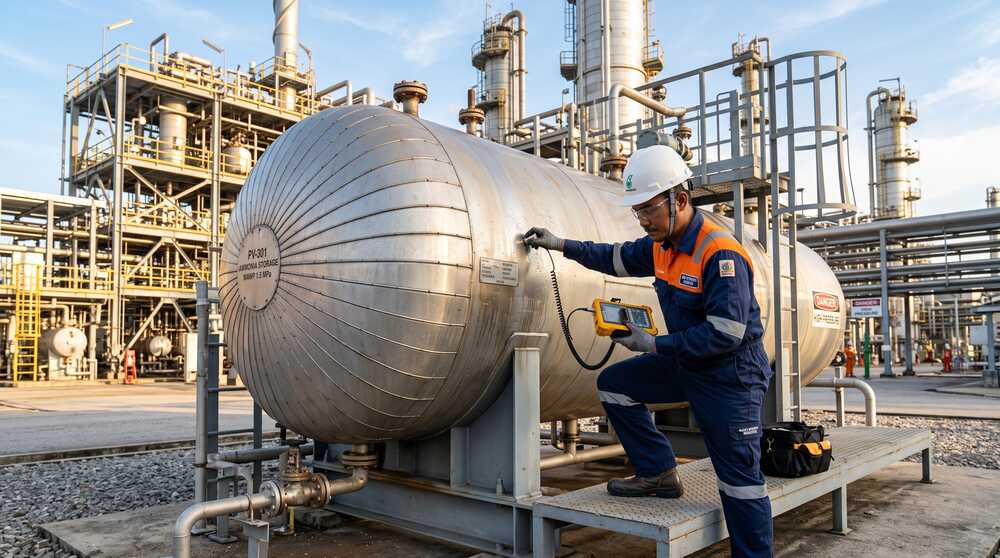
- What: A mechanical integrity program is a systematic framework for ensuring that critical process equipment pressure vessels, piping, relief devices, tanks, and rotating machinery is designed, installed, operated, and maintained to prevent failures that could lead to hazardous releases.
- Why: Mechanical integrity is one of the 14 elements of Process Safety Management (PSM) and one of the most frequently cited areas during regulatory audits making a robust MI programme both a safety imperative and a compliance necessity.
- Problem: Many Malaysian process facilities struggle with fragmented MI programmes that lack documented procedures, consistent inspection frequencies, or integration with other PSM elements such as management of change and process hazard analysis.
- Solution: A comprehensive mechanical integrity program aligned with OSHA PSM requirements, API standards, and PETRONAS Technical Standards ensures equipment reliability, prevents loss of containment events, and reduces unplanned downtime.
- Next Step: Engage an experienced integrity engineering consultancy to assess your current MI programme against industry best practices and develop a roadmap for improvement.
What is a Mechanical Integrity Program?
A mechanical integrity program is the structured set of policies, procedures, inspections, testing, and quality assurance activities that ensure critical process equipment maintains its ability to contain hazardous materials safely throughout its operational life. It is the practical implementation of the principle that equipment should never fail in a way that causes or contributes to a release of highly hazardous chemicals.
Under OSHA’s Process Safety Management standard (29 CFR 1910.119), mechanical integrity is designated as Element (j) one of the most critical and most frequently cited elements during compliance audits. The standard requires that the following categories of equipment be covered by a mechanical integrity program: pressure vessels and storage tanks, piping systems (including components such as valves), relief and vent systems and devices, emergency shutdown systems, controls and safety-critical instrumentation, and pumps and rotating equipment.
A well-designed MI programme goes beyond periodic inspection. It encompasses the entire equipment lifecycle from design and fabrication standards, through procurement and installation quality assurance, to in-service inspection, testing, preventive maintenance, and ultimately repair or replacement decisions.
In the Malaysian context, mechanical integrity requirements are shaped by a combination of the Occupational Safety and Health Act 1994, DOSH regulations (including the SSI Regulations 2025), PETRONAS Technical Standards, and international codes such as API 510, API 570, API 571, API 579, and ASME standards. For plant operators, this means the MI programme must satisfy both local regulatory requirements and international best practices.
The relationship between mechanical integrity and asset integrity management is often a source of confusion. Put simply: mechanical integrity is a PSM element focused on preventing safety-critical equipment failures. Asset integrity management is the broader framework that manages all assets safety-critical or otherwise across their lifecycle. A good MI programme feeds into and draws from the AIM framework.
Malaysian Data & Regulatory Context
Malaysia’s regulatory framework for mechanical integrity has evolved significantly. The launch of the SSI Regulations 2025 by PETRONAS and DOSH embedded risk-based inspection into asset management practices, directly impacting how mechanical integrity programmes are structured and executed.
Under the SSI Regulations 2025, plant owners must collect and maintain risk-based data at least every 12 months and use approved methods for risk assessment. This means MI programmes can no longer rely solely on time-based inspection schedules they must incorporate risk-based approaches aligned with API 580/581 methodology.
A peer-reviewed case study published in the Journal of Engineering Research and Reports (2021) found that process safety management in Malaysia is strongly influenced by PETRONAS’ Mandatory Control Framework, which includes mechanical integrity as a core requirement. The study noted that the 14 elements of PSM including mechanical integrity, process hazard analysis, and management of change are closely integrated in the Malaysian oil and gas sector.
Data from OSHA’s Refinery National Emphasis Program in the United States provides a cautionary parallel: mechanical integrity alone has historically accounted for nearly 30% of all PSM citations during regulatory audits. While Malaysian enforcement data is less publicly available, our experience working with facilities across the country confirms that MI programme gaps are among the most common findings during internal audits and regulatory reviews.
For plant managers in Malaysia’s petrochemical corridors Kertih, Gebeng, Bintulu, and the Pengerang Integrated Complex a robust mechanical integrity program is not optional. It is the frontline defence against loss of containment events that can result in fires, explosions, toxic releases, and catastrophic business losses.
How a Mechanical Integrity Program Functions

A comprehensive MI programme operates through five interconnected components, as defined by OSHA’s PSM guidance:
- Written Procedures The MI programme must have documented procedures for inspection, testing, and maintenance of every category of covered equipment. These procedures must specify what is inspected, how it is inspected, the acceptance criteria, the inspection frequency, and the actions to be taken when deficiencies are found. Procedures should reference applicable codes API 510 for pressure vessels, API 570 for piping, and API 576 for pressure relief devices.
- Training All employees and contractors involved in maintaining process equipment must be trained in the hazards of the processes they work on and in the procedures applicable to their specific job tasks. Training must cover not just the mechanical procedures themselves, but the safety context why the equipment is critical and what the consequences of failure could be.
- Inspection and Testing Inspections and tests must be performed at frequencies consistent with manufacturer recommendations and good engineering practice. For equipment covered by risk-based inspection (RBI) programmes aligned with API 580/581, inspection intervals can be optimised based on actual risk rather than arbitrary calendars but only if the RBI programme is properly implemented.
- Deficiency Correction When inspections reveal deficiencies, the MI programme must have a process for addressing them. This includes documenting the finding, assessing the risk, determining the appropriate corrective action (repair, replace, de-rate, or monitor), and tracking the action to completion. Root cause analysis should be applied to recurring deficiencies to prevent repeated failures.
- Quality Assurance The MI programme must ensure that new equipment, replacement parts, and maintenance materials meet design specifications and applicable codes. This includes verification of material certifications, welding procedure qualifications, and compliance with original design standards such as ASME Section VIII.
Risk Factors
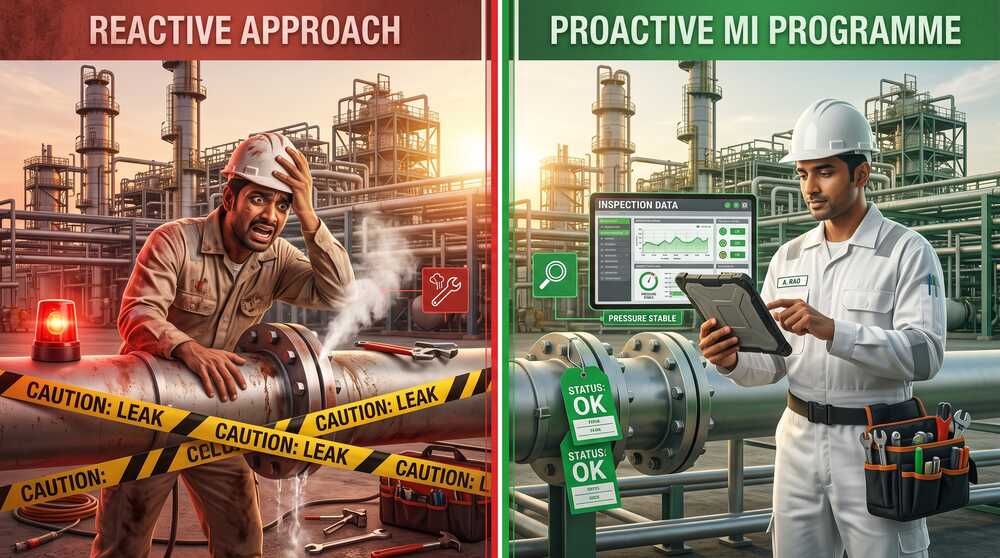
Inadequate Documentation: One of the most common MI programme weaknesses is incomplete or missing documentation inspection records that cannot be located, procedures that have not been updated, or equipment that has been modified without corresponding documentation updates.
Fragmented Data Systems: Many Malaysian plants store MI data across multiple systems CMMS, spreadsheets, paper files, and legacy databases. Without a centralised system, it becomes impossible to track inspection history, corrosion rates, and deficiency closure effectively.
Insufficient Training: Maintenance personnel who lack understanding of the safety context of their work may not recognise the significance of inspection findings or may take shortcuts during testing procedures. OSHA guideline suggests that MI training extend beyond procedures to include the hazards of the process.
Lack of Integration with Other PSM Elements: A mechanical integrity program cannot function in isolation. It depends on accurate process safety information for design data and acceptance criteria. It must interface with management of change (MOC) procedures so that equipment modifications trigger reassessment.
Deferred Maintenance: When inspection findings reveal deficiencies that are not corrected promptly due to budget constraints, production pressures, or turnaround scheduling the risk of equipment failure increases progressively. A robust MI programme must have clear escalation procedures for overdue deficiency corrections.
Industry Myths vs. Reality
| Myth | Reality |
|---|---|
| “We have a CMMS, so we have a mechanical integrity program.” | A CMMS is a tool, not a programme. An MI programme requires documented procedures, trained personnel, defined inspection criteria, deficiency correction processes, and quality assurance the CMMS simply helps manage the data. |
| “Mechanical integrity is the maintenance department’s responsibility.” | MI is a PSM element that requires involvement from operations, engineering, safety, and management. The maintenance team executes inspections, but the programme must be owned at a leadership level. |
| “We inspect everything on a fixed schedule that’s good enough.” | Time-based inspection is not risk-based inspection. Under the SSI Regulations 2025, facilities are expected to adopt risk-informed approaches that focus resources on the highest-risk equipment while safely deferring low-risk items. |
| “API 510/570 certification means our inspectors can handle everything.” | API certification covers inspection methodology for specific equipment types. A comprehensive MI programme also requires competencies in corrosion engineering, damage mechanism identification, fitness-for-service assessment, and reliability analysis. |
| “Small plants don’t need a formal MI programme.” | Any facility operating pressure equipment, piping, or relief devices regardless of size benefits from a structured MI programme. DOSH requirements apply across all sectors, and equipment failures at small facilities can be just as catastrophic. |
Our Experience at Pure Integrity
Facing Industry Challenges
In our work across Malaysian process facilities, we frequently encounter MI programmes that exist on paper but lack practical implementation. Common patterns include inspection procedures that reference outdated codes, training records that cover only general safety rather than process-specific hazards, and deficiency correction processes that lack clear timelines and accountability.
We have worked with facilities where pressure relief devices had not been tested within the manufacturer-recommended intervals, where piping inspection records could not be traced to specific circuits, and where quality assurance for replacement parts consisted of little more than checking purchase orders.
Solving Mechanical Integrity Challenges
At Pure Integrity, we approach mechanical integrity as an integrated element of the broader PSM framework not as a standalone maintenance activity. Our team works with your operations, maintenance, and engineering groups to assess the current state of your MI programme, identify gaps against regulatory requirements and industry best practices, and develop a practical improvement roadmap.
Our core capabilities that support mechanical integrity programmes include:
Risk-Based Inspection (RBI): Our RBI services help transition MI programmes from time-based to risk-based approaches, optimising inspection resources.
Root Cause Analysis (RCA): Our RCA capability helps identify the true causes of recurring equipment failures, preventing repeat deficiencies.
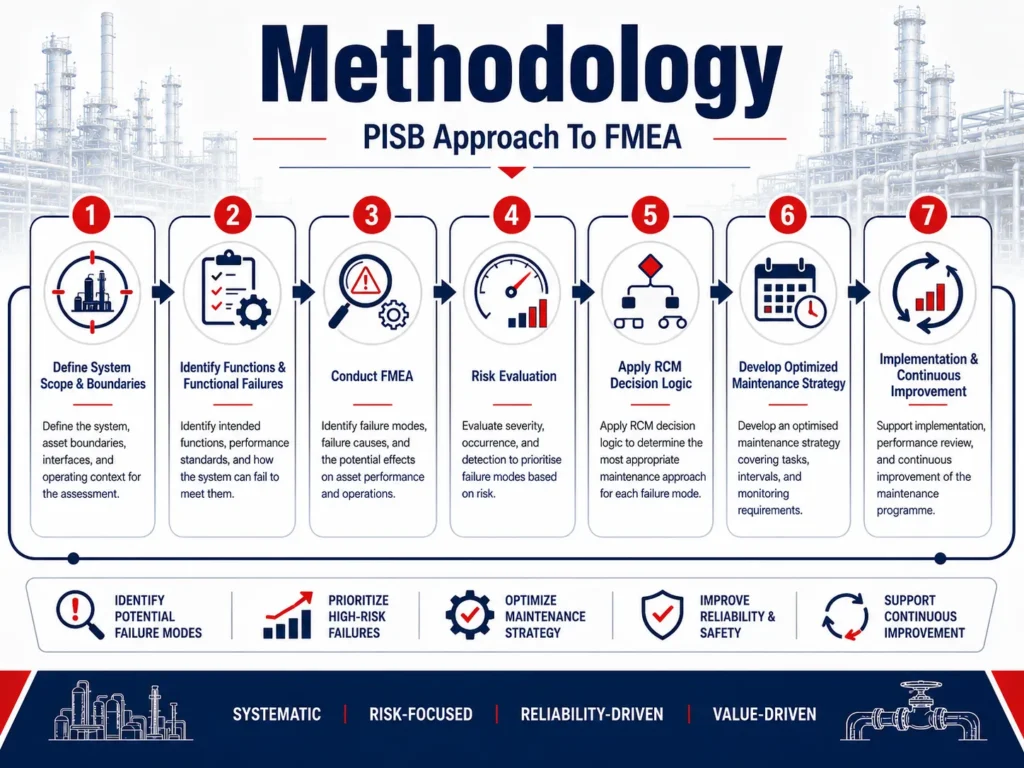
FMEA: Our failure mode and effect analysis approach optimises preventive maintenance strategies within the MI programme.
Reliable Centred Maintenance (RCM): Our RCM methodology helps prioritise maintenance activities based on equipment criticality and failure consequences.
Our Procedure for Mechanical Integrity Programme Development
Step 1: MI Programme Gap Assessment We evaluate your current MI programme against OSHA PSM requirements, API standards, PETRONAS Technical Standards, and DOSH regulations.
Step 2: Equipment Criticality Assessment We classify all covered equipment by criticality based on consequence of failure, process hazard severity, and regulatory requirements.
Step 3: Procedure Development & Update We develop or update written MI procedures for each equipment category, specifying inspection methods, frequencies, acceptance criteria, and corrective action processes.
Step 4: Training Programme Design We design MI training programmes that cover process hazards, equipment-specific procedures, and the safety context of mechanical integrity activities.
Step 5: Inspection & Testing Programme We establish risk-informed inspection and testing schedules aligned with API codes and manufacturer recommendations, integrated with RBI methodology.
Step 6: Performance Monitoring We help establish MI key performance indicators (KPIs) to track programme effectiveness and drive continuous improvement.
Expert Commentary
Mechanical integrity is where process safety meets engineering reality. On paper, every facility has an MI programme. In practice, the quality of that programme varies enormously and the gap between documentation and reality is where incidents happen.
Experts suggest that Malaysian plant operators focus on three priorities. First, ensure that MI procedures are current, code-compliant, and actually used by the maintenance workforce not just filed in a document management system. Second, establish a clear link between the MI programme and the facility’s management of change process every modification that affects safety-critical equipment must trigger an MI review. Third, invest in MI-specific training that goes beyond generic safety awareness to cover the process hazards, equipment characteristics, and inspection techniques relevant to each equipment category.
The integration of mechanical integrity with alarm management and process safety management is particularly important. DOSH dan PETRONAS suggests that MI programme findings feed into the facility’s risk register and inform decisions about turnaround scope, capital budgets, and equipment life extension.
When Should You Seek Professional Consultancy?
Regulatory Audit Preparation: An external MI programme assessment can identify gaps before regulators do.
Post-Incident Review: Equipment failures or near-misses should trigger a comprehensive MI programme review.
Transitioning to RBI: Moving from time-based to risk-based inspection requires specialised expertise.
Ageing Facilities: Plants operating beyond original design life need enhanced MI programmes that address age-related degradation mechanisms.
Mergers & Acquisitions: Baseline MI assessments are critical due diligence.
New Plant Commissioning: Establishing an MI programme during construction ensures compliance from day one.
What equipment must be included in a mechanical integrity program?
Under PSM requirements, the MI programme must cover pressure vessels and storage tanks, piping systems including valves, relief and vent systems, emergency shutdown systems, controls and safety-critical instrumentation, and pumps. Facilities may extend coverage to additional equipment deemed critical to process safety.
How does mechanical integrity relate to process safety management?
Mechanical integrity is one of the 14 elements of the PSM framework. It is interdependent with other elements including process safety information (which provides design data), process hazard analysis (which identifies safety-critical equipment), management of change (which triggers MI reassessment), and incident investigation (which may reveal MI programme gaps).
What is the difference between mechanical integrity and asset integrity?
Mechanical integrity is a PSM element focused specifically on preventing safety-critical equipment failures that could lead to hazardous releases. Asset integrity management is the broader framework that manages all assets across their lifecycle including non-safety-critical equipment for reliability, performance, and cost optimisation. MI is a subset of AIM.
What standards govern mechanical integrity programmes in Malaysia?
The primary framework includes OSHA PSM (29 CFR 1910.119) as the foundational reference, PETRONAS Technical Standards for oil and gas facilities, DOSH SSI Regulations 2025 for risk-based inspection, API 510/570/571/576/579 for specific equipment inspection, and ASME standards for design and fabrication.
How often should mechanical integrity programme effectiveness be assessed?
Best practice is to conduct a formal MI programme assessment annually, with a comprehensive review every 3 to 5 years. Additionally, MI programme effectiveness should be assessed after any significant equipment failure, regulatory audit finding, or management of change that affects safety-critical equipment.
Conclusion
A mechanical integrity program is the engineering backbone of process safety management. Without it, hazardous materials stay contained only by luck. With a robust, well-implemented MI programme, they stay contained by design, discipline, and diligence.
In Malaysia’s evolving regulatory landscape shaped by the SSI Regulations 2025, PETRONAS Technical Standards, and international best practices a comprehensive mechanical integrity program is not optional. It is the minimum standard for any facility that takes process safety seriously.
At Pure Integrity, we bring the engineering expertise, regulatory knowledge, and field experience to help your facility build, assess, and strengthen its mechanical integrity programme. Reach out to our team because keeping the hazardous materials inside the pipes is everyone’s most important job.
References
- OSHA, “Process Safety Management of Highly Hazardous Chemicals (OSHA 3132).” Akses: https://www.osha.gov/sites/default/files/publications/OSHA3132.pdf
- OSHA, “PSM Standard Appendix C Compliance Guidelines for Mechanical Integrity.” Akses: https://www.osha.gov/laws-regs/regulations/standardnumber/1910/1910.119AppC
- PETRONAS, “PETRONAS and DOSH Mark Regulatory Milestone with Launch of SSI Regulations 2025,” 12-August-2025. Akses: https://www.petronas.com/media/media-releases/petronas-and-dosh-mark-regulatory-milestone-launch-ssi-regulations-2025
- Inspectioneering, “OSHA PSM Citations for Mechanical Integrity.” Akses: https://inspectioneering.com/journal/1995-05-01/60/osha-psm-citations-for-mechani
- Journal of Engineering Research and Reports, “A Case Study of Asset Integrity and Process Safety Management of Major Oil and Gas Companies in Malaysia,” 2021. Akses: https://doi.org/10.9734/jerr/2021/v20i217260
- DOSH Malaysia, “Guidelines on Occupational Safety and Health Management Systems.” Akses: https://dosh.gov.my/wp-content/uploads/2024/10/Garis-Panduan-bagi-Sistem-Pengurusan-Keselamatan-dan-Kesihatan-Pekerjaan-OSHMS.pdf
- SafetyCulture, “Mechanical Integrity: Meaning & Requirements,” 2026. Akses: https://safetyculture.com/topics/process-safety-management/mechanical-integrity
This article had been reviewed by
Dr. Khairil Osman – A TUV Certified Functional Safety Engineer who graduated from the University of Southampton and works as Operation Director at Pure Integrity.