In high-hazard industries, understanding risk is not enough. Organisations must be able to communicate it – clearly, visually, and in a way that every level of the workforce can act upon.
BowTie Analysis is one of the most powerful tools available for doing exactly that.
What Is BowTie Analysis?
BowTie Analysis is a visual risk assessment methodology that maps how threats lead to a major accident event and how barriers – both preventive and mitigative – are in place to stop those threats from escalating into catastrophic consequences.
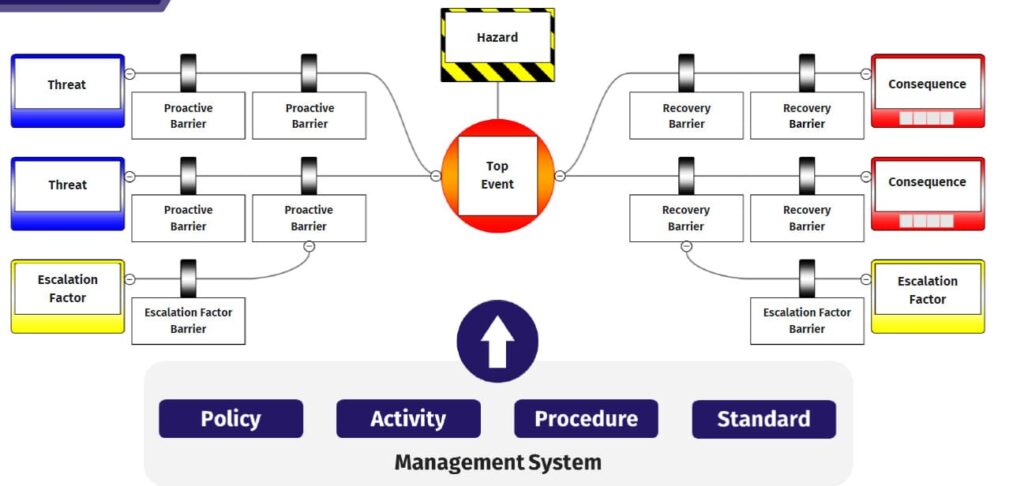
The diagram takes its name from its shape. At the centre sits the Top Event – the precise moment when control over a hazard is lost, such as a sudden loss of containment or a pressure vessel rupture.
On the left side of the diagram, all plausible threats (causes) leading to the Top Event are identified. On the right, all potential consequences are mapped. Bridging both sides are the barriers: the engineered systems, administrative controls, and human interventions that either prevent the Top Event from occurring or limit its impact once it has.
Unlike traditional risk assessment tools such as fault trees or event trees, which are used separately, BowTie Analysis combines both into a single, integrated picture.
The result is a diagram that gives organisations a complete view of multiple risk scenarios at a glance.
Why BowTie Analysis Matters for Major Accident Hazards
Major Accident Hazards (MAHs) the loss of flammable, toxic, or explosive materials with the potential to cause mass casualties or significant environmental damage, demand a level of risk visibility that conventional checklists and registers cannot provide.
BowTie Analysis addresses this directly. By making the relationship between threats, barriers, and consequences explicit and visual, it enables organisations to:
- Identify barrier weaknesses
Degradation factors that could cause a barrier to fail are mapped directly onto the diagram, allowing proactive maintenance and inspection prioritisation. - Support Management of Change (MOC)
When process conditions or equipment change, the BowTie provides a structured framework to assess whether existing barriers remain sufficient. - Drive workforce understanding
Operators and technicians can see, in a single diagram, why their specific tasks matter and how they fit into the broader system of protection. - Strengthen regulatory compliance
BowTie Analysis supports requirements under process safety frameworks including OSHA PSM, COMAH, and Malaysia’s DOSH Major Hazard regulations. - Facilitate process safety auditing
Auditors can follow the barrier structure on the diagram to verify that each control measure is in place, functioning and regularly tested.
This is why BowTie Analysis is increasingly recognised not just as a risk assessment tool, but as a barrier management system.
BowTie Analysis and Its Place in the PSM Framework
BowTie Analysis does not stand alone. Its greatest value is realised when it is integrated into a broader Process Safety Management (PSM) programme.
HAZOP and HAZID studies identify the hazards and deviations, the BowTie then gives those findings a visual structure that can be used across operations, engineering, and management. Where LOPA determines whether sufficient layers of protection exist quantitatively, the BowTie communicates the same protection logic qualitatively and accessibly.
For facilities where Safety Instrumented Systems (SIS) are deployed, the BowTie diagram provides the context in which those systems operate, showing precisely which consequence scenario each Safety Instrumented Function (SIF) is designed to prevent, and what other barriers exist alongside it.
The Human Element in BowTie Development
A BowTie diagram is only as accurate as the knowledge that goes into building it. This is why experienced facilitation matters.
Fasyan Sabri, P.Eng, ACPE, TUV FSE, Head of Technical Services at Pure Integrity, understands this from direct field experience.
Having led a team through the first adoption of the bowtie and visualization of LOPA through bowtie, Fasyan has seen first-hand how quickly barrier integrity can be challenged under operational pressure and how bowtie can help visualise the overall scenario for better decision making.

That kind of experience is what separates a well-constructed BowTie from one that looks complete on paper but misses the real-world failure modes that frontline personnel encounter every day.
Effective BowTie development draws on both, technical rigour and hard-won operational knowledge.
How Pure Integrity Can Help
At Pure Integrity Sdn. Bhd., our consultants facilitate BowTie Analysis as part of a comprehensive process safety service offering. Whether you are developing BowTies during the design phase, integrating them into an existing PSM programme, or using them to support a safety case or regulatory submission, we bring the technical depth and field experience to deliver analysis that is both credible and practical. We are also a reseller for BowTieXP, the gold standard in bowtie visualization software.
Our services also include Field Services, HAZOP and HAZID studies, LOPA and SIL Assessment, Functional Safety Assessment (FSA), and Alarm Rationalisation – across oil and gas, petrochemical, and power generation sectors in Malaysia and Southeast Asia.
To discuss your BowTie Analysis or process safety needs, contact us today at https://pureintegrity.co/contact-us/
References :
1. Energy Institute & CCPS, Bow Ties in Risk Management: A Concept Book for Process Safety, Energy Institute (EI) & Center for Chemical Process Safety (CCPS). Akses: https://www.energyinst.org/technical/publications/topics/human-and-organisational-factors/bow-ties-in-risk-management-a-concept-book-for-process-safety
2. IChemE, The Use of Bow Ties in Process Safety Auditing, IChemE Hazards 26 Symposium Series No. 161. Akses: https://www.icheme.org/media/11749/hazards-26-paper-12-the-use-of-bowtie-analysis-in-process-safety-auditing.pdf
3. IChemE, Bow Ties in Risk Management – Key Recommendations from the New CCPS/EI Concept Book, IChemE Hazards 28 Symposium Series No. 163. Akses: https://www.icheme.org/media/16937/hazards-28-paper-31.pdf
—
Published by Pure Integrity Sdn. Bhd. – Leading Safety & Integrity Engineering Consultant In Malaysia
Image source:
https://www.juliantalbot.com/post/risk-bow-tie-method
https://riskonnect.com/en-gb/reporting-analytics-en-gb/what-is-bowtie-analysis-in-risk-management/