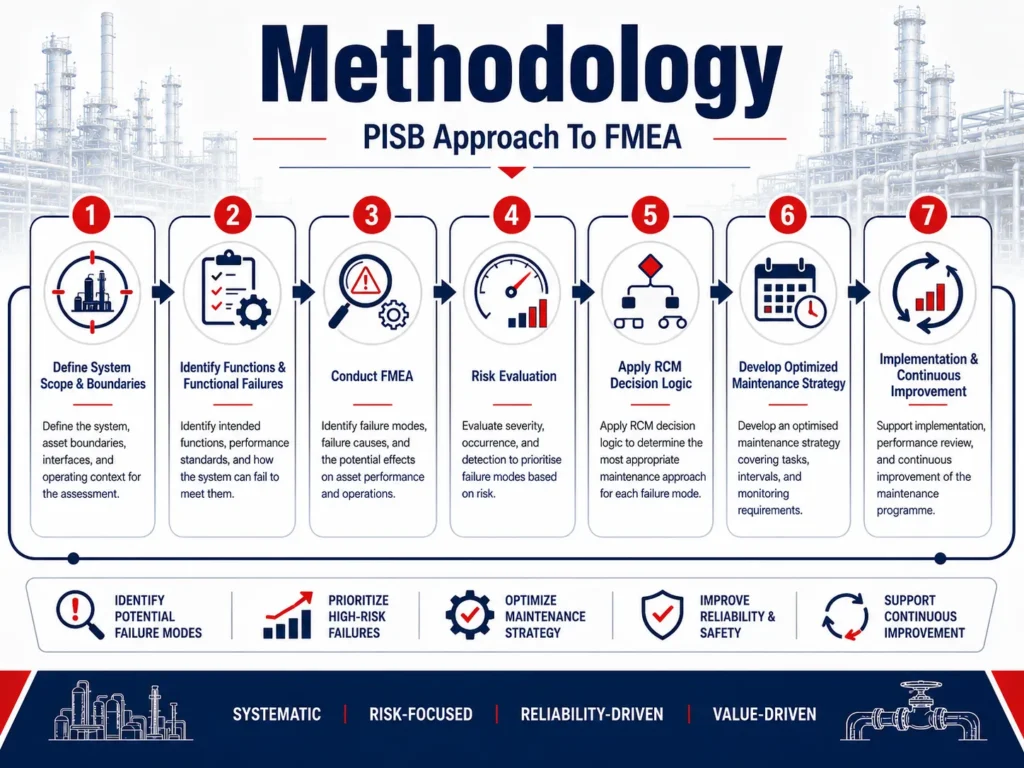

One of the most common conversations I have with maintenance managers and plant engineers is about maintenance strategy specifically, whether their current approach is actually calibrated to the assets they are managing, or whether it is simply the schedule they inherited and never questioned.
For many years, Preventive Maintenance was the dominant framework: service equipment at fixed intervals, replace components before they fail, and trust that the routine will keep things running. It worked well enough for simpler systems and smaller asset populations. But as industrial facilities grew more complex, and as the cost of over-maintaining low-risk equipment while under-maintaining critical assets became more apparent, a more structured approach emerged.
Reliable Centered Maintenance (RCM) is that approach. It asks harder questions about equipment: not just “when should we service this?” but “how can this fail, what happens if it does, and what is the most effective action to prevent or mitigate that failure?” The answers drive a maintenance strategy that is far more precisely matched to operational reality.
In this article I want to explain both methodologies clearly, compare them honestly, and share what I have learned about when and how to apply each or how to combine them.
What is Reliable Centered Maintenance?
Reliability Centred Maintenance (RCM) is a structured engineering process for determining the most appropriate maintenance strategy for each asset based on its function, its potential failure modes, and the consequences of those failures.
Rather than applying a standard service interval across a category of equipment, RCM works through a disciplined set of questions:
- What functions does this asset perform in its current operating context?
- In what ways can it fail to perform those functions?
- What causes those failure modes?
- What happens when each failure occurs?
- Does each failure matter and in what way?
- What can be done to prevent or mitigate it?
By working systematically through these questions for each asset, engineers arrive at maintenance strategies that are justified by engineering logic rather than convention. Some assets will require more frequent attention than a standard PM schedule would suggest. Others will require less. Some will be better served by condition monitoring than by periodic servicing. And in some cases, the analysis concludes that allowing a failure to occur and managing the consequences is the most appropriate strategy.
RCM was originally developed for the aviation industry, where the stakes of getting maintenance strategy wrong are obvious and immediate. Its principles have since been adopted across oil and gas, power generation, manufacturing, and other sectors where equipment reliability has direct safety and operational consequences.
What is Preventive Maintenance?
Preventive Maintenance (PM) is the more familiar approach: equipment is serviced or inspected at predetermined intervals on a time basis, a cycle basis, or a usage basis with the objective of preventing failures before they occur.
Typical PM activities include routine equipment inspections, lubrication and cleaning, replacement of components at defined life limits, and calibration and performance checks. The approach is straightforward to administer and produces a clear, auditable maintenance record.
The limitation of PM is that it does not inherently consider whether the scheduled maintenance task is actually the most effective response to the failure modes the asset is susceptible to. It assumes that servicing at regular intervals will prevent failure but this assumption does not hold for all failure patterns. Many equipment failures are not strongly age-related; they are driven by specific operating conditions, process chemistry, or accumulated stress that a calendar-based schedule does not capture.
What I have observed in practice is that facilities running purely time-based PM programmes often have two problems simultaneously: they are over-maintaining some equipment, spending engineering effort on assets that do not need it, while under-maintaining others whose actual failure risk is not reflected in the schedule. Neither outcome serves the facility or its people well.
Key Differences: RCM vs. Preventive Maintenance
The most fundamental difference between RCM and preventive maintenance is the question each one starts with. Preventive maintenance starts with: “when should we maintain this?” RCM starts with: “how can this fail, and what is the right response?”
RCM is function-driven and failure-mode-driven. PM is schedule-driven. RCM produces maintenance strategies that vary by asset, failure mode, and consequence. PM tends to apply uniform intervals across asset categories. RCM considers the full range of maintenance options including condition monitoring, redesign, and failure-finding tasks alongside traditional servicing. PM is primarily focused on time-based servicing and component replacement.
This does not make PM wrong. It makes it less precise and precision matters more as asset populations age, as operating conditions become more demanding, and as the cost of both over-maintenance and unexpected failure increases.
Advantages of Reliability Centred Maintenance
Improved Equipment Reliability
By focusing on actual failure modes rather than assumed failure patterns, RCM helps organisations address the root causes of equipment problems rather than managing symptoms. The result is fewer unexpected failures and more predictable asset performance.
Better Maintenance Efficiency
Maintenance resources flow to assets and tasks that genuinely need attention. Effort is not wasted on low-risk equipment while high-risk assets wait their turn in a uniform queue.
Reduced Operational Costs
Optimised maintenance planning reduces unnecessary component replacements and excessive inspections. Over a multi-year horizon, the cost savings from eliminating redundant maintenance tasks are typically significant often more than enough to fund the RCM analysis itself.
Enhanced Safety
Failures with serious safety consequences are specifically identified through the RCM process and receive appropriately rigorous maintenance treatment. The methodology is designed to ensure that nothing with a significant safety consequence is allowed to fail without a specific, defensible maintenance strategy in place.
Industry bodies such as the Society for Maintenance and Reliability Professionals (SMRP) recognise RCM-based approaches as best practice for modern maintenance management, and this is increasingly reflected in the expectations of Malaysian regulatory bodies as well.
When Preventive Maintenance is Still Useful

Despite the advantages of RCM, preventive maintenance retains an important role. Many routine maintenance tasks lubrication, cleaning, filter changes, calibration are justified on operational grounds regardless of a detailed failure mode analysis. They maintain baseline performance and prevent minor issues from escalating into significant ones.
What I typically find when working with facilities on maintenance strategy is that PM provides a useful foundation the baseline activities that keep equipment operational while RCM provides the analytical layer that ensures the higher-consequence items are getting the specific attention they actually need.
The two are not competitors. They are complementary. The facilities that manage their assets most effectively are generally those that have used RCM thinking to interrogate and refine their PM schedules, eliminating tasks that cannot be justified and strengthening those that can.
Integrating RCM with Modern Maintenance Systems
In practice, modern maintenance programmes rarely rely on a single methodology. RCM is commonly integrated with condition monitoring, predictive maintenance technologies, and asset integrity frameworks each providing a different lens on the same equipment population.
Condition monitoring tells you what is happening to an asset right now. Predictive maintenance uses that data to project when intervention will be needed. RCM provides the strategic framework that determines what intervention is appropriate and why. Together, they produce a maintenance system that is both technically rigorous and operationally practical.
Having facilitated technical sessions on risk management at conferences including Loss Prevention Asia, I have seen how facilities across the region are at very different stages of this journey. Some are still running purely time-based schedules with no risk basis at all. Others have integrated advanced condition monitoring and digital maintenance management platforms. What the most effective ones share is a common commitment: they know why they are doing what they are doing, and they can justify it.
In Malaysia, DOSH expectations around safe operational standards, and PETRONAS Technical Standards for oil and gas operators, both support and increasingly encourage the adoption of reliability-based maintenance approaches. A well-structured RCM programme is also one of the clearest ways an organisation can demonstrate to regulators that its maintenance decision-making is grounded in engineering analysis rather than habit.
Conclusion
Both Reliability Centred Maintenance and Preventive Maintenance have a place in a well-designed maintenance programme. PM provides the structured routine that keeps equipment operational day to day. RCM provides the analytical rigour that ensures the most critical assets are being managed in the most effective way.
For organisations managing complex industrial systems especially those with aging assets or high-consequence equipment the combination of these strategies, applied thoughtfully and continuously refined through data, is what produces genuinely reliable and safe operations.
The investment in getting maintenance strategy right pays for itself. Not just in avoided failures, but in the confidence of knowing that your programme is built on engineering logic, not convention.
References
1. SAE International, SAE JA1011 — Evaluation Criteria for Reliability-Centered Maintenance (RCM) Processes, November-2024. Access: https://www.sae.org/standards/ja1011_202411-evaluation-criteria-reliability-centered-maintenance-rcm-processes
2. SAE International, SAE JA1012 — A Guide to the Reliability-Centered Maintenance (RCM) Standard, (edisi semakan). Access: https://ifmaindy.org/images/downloads/RCM/a_guide_to_the_rel_centered_maint_rcm_standard.pdf
3. ASME Digital Collection — Journal of Engineering for Gas Turbines and Power, A Dynamic Reliability-Centered Maintenance Analysis Method for Natural Gas Compressor Station Based on Diagnostic and Prognostic Technology (Zhou et al.), Jun-2016. Access: https://asmedigitalcollection.asme.org/gasturbinespower/article/138/6/061601/374178/A-Dynamic-Reliability-Centered-Maintenance
4. ResearchGate / International Journal, Critical Success Factors of the Reliability-Centred Maintenance Implementation in the Oil and Gas Industry, 2020. Access: https://www.researchgate.net/publication/345401270_Critical_Success_Factors_of_the_Reliability-Centred_Maintenance_Implementation_in_the_Oil_and_Gas_Industry
5. TWI Global, What is Asset Integrity Management? — Definition and Guide (including RCM Framework), (tarikh tidak dinyatakan awam). Access: https://www.twi-global.com/technical-knowledge/faqs/asset-integrity-management
This article has been reviewed and validated by:
He is a TUV Certified Functional Safety Engineer who graduated from the University of Southampton and serves as Operation Director at Pure Integrity.