
- Asset integrity assessment is a systematic evaluation of equipment condition, degradation mechanisms, and fitness-for-service to ensure industrial assets remain safe, reliable, and compliant throughout their operational lifecycle.
- Malaysian industrial plants face ageing infrastructure, tighter regulatory enforcement under the SSI Regulations 2025, and increasing scrutiny from DOSH , making structured integrity assessments more critical than ever.
- Many plant operators still rely on time-based inspection schedules that miss hidden degradation, leading to unexpected shutdowns, loss of containment events, and costly emergency repairs.
- A risk-based asset integrity assessment programme aligned with API 580/581 and ISO 55001 helps prioritise high-risk equipment, extend inspection intervals safely, and reduce total cost of ownership.
- Next Step: Engage a qualified integrity engineering consultancy to conduct a baseline asset integrity assessment and develop a prioritised inspection roadmap for your facility.
What is Asset Integrity Assessment?
Asset integrity assessment is the structured process of evaluating the physical condition, performance capability, and remaining useful life of industrial equipment , from pressure vessels and heat exchangers to piping systems, storage tanks, and rotating machinery. It goes beyond routine visual inspection to include advanced non-destructive testing (NDT), corrosion rate analysis, fitness-for-service (FFS) evaluations, and risk-based decision-making.
At its core, an asset integrity assessment answers one fundamental question: is this equipment safe to continue operating under current conditions, and for how long?
The scope of a thorough assessment typically covers mechanical integrity of pressure-containing equipment, structural integrity of load-bearing components, protective systems such as pressure relief devices and safety instrumented systems (SIS), corrosion monitoring and degradation mechanism identification, as well as documentation review against original design codes such as ASME Section VIII and API 510/570.
Unlike a one-off inspection, asset integrity assessment is embedded within a broader asset integrity management (AIM) framework. It is the data-gathering engine that feeds into risk-based inspection (RBI) programmes, life extension studies, and turnaround planning. When executed properly, it transforms reactive maintenance into a proactive, risk-informed strategy.
International standards such as ISO 55001 define asset integrity assessment as part of a lifecycle asset management system , one that considers performance, risk, and cost from acquisition through to decommissioning. In the Malaysian context, the PETRONAS Technical Standards (PTS) and DOSH regulatory framework further define the minimum requirements for equipment integrity evaluation in oil and gas, petrochemical, and process industries.
Malaysian Data & Regulatory Context

Malaysia’s industrial landscape has undergone a significant regulatory shift in recent years. The gazetting of the Occupational Safety and Health (Special Scheme of Inspection) Regulations 2025 , commonly known as the SSI Regulations 2025 , marks the most important milestone for asset integrity assessment in the country’s history.
Launched jointly by PETRONAS and DOSH in August 2025, the SSI Regulations 2025 replaced the earlier Factories and Machinery (SSI) Regulations 2014 and formally embedded risk-based inspection into the core of asset management practices across Malaysian industries. Under these regulations, plant owners are now required to collect and maintain risk-based data at least every 12 months, use approved methods for calculating and assessing risk data, and notify the Director General within 30 days if the leader of the RBI team changes.
This regulatory evolution reflects a broader industry reality. Malaysia’s oil and gas infrastructure is ageing , many offshore platforms and onshore refineries have been operating for 25 to 40 years, well beyond their original design life. The PETRONAS Carigali structural integrity management programme, for instance, was established in 2008 specifically to address the challenge of extending the life of fixed offshore structures that face loading conditions beyond original design parameters.
A peer-reviewed study published in Process Safety Progress (Mohamed, 2018) documented the transition from time-based inspection to risk-based inspection in Malaysian industry following the gazette of the original SSI 2014 regulations. The study noted that upon successful demonstration of compliance, the Certificate of Fitness for pressurised equipment could be extended to a maximum of 72 months , a significant incentive for plant operators who invest in proper asset integrity assessment programmes.
Research published in the Journal of Engineering Research and Reports (2021) further confirmed that asset integrity is closely intertwined with process safety in Malaysia, where PETRONAS’ Mandatory Control Framework and the US OSHA 3132 framework together shape the requirements for mechanical integrity, management of change, and compliance audits.
For plant managers and facility engineers in Malaysia, the message is clear: asset integrity assessment is no longer optional , it is a regulatory mandate, an operational necessity, and a commercial advantage.
How Asset Integrity Assessment Functions in Practice
A robust asset integrity assessment programme operates across four interconnected phases: data gathering, risk evaluation, inspection execution, and action planning.
Phase 1: Asset Register & Data Gathering
Every assessment begins with establishing a comprehensive asset register. This includes design data (material specifications, design pressure, temperature ratings), fabrication records, historical inspection reports, process operating conditions, and any previous repair or modification records. In our experience, this is where many Malaysian plants fall short , years of accumulated data may be scattered across spreadsheets, paper files, and different software systems. A proper data consolidation exercise is essential before any meaningful risk analysis can begin.
Phase 2: Risk Assessment & Prioritisation
Using the gathered data, each asset is evaluated for its probability of failure (PoF) and consequence of failure (CoF). This is the foundation of risk-based inspection (RBI) as defined in API RP 580 and quantified through API RP 581. The outcome is a risk matrix that categorises equipment into high, medium, and low-risk tiers , allowing inspection resources to be focused where they matter most.
Phase 3: Inspection Execution & NDT
Based on the risk prioritisation, targeted inspections are carried out using appropriate techniques. These may include ultrasonic thickness measurement (UTM), magnetic particle testing (MPT), radiographic testing, acoustic emission monitoring, and increasingly, remote visual inspection using drones. The choice of technique depends on the degradation mechanism identified , for example, pulsed eddy current testing is preferred for detecting corrosion under insulation (CUI), while phased array ultrasonic testing (PAUT) provides superior detection of stress corrosion cracking.
Phase 4: Fitness-for-Service & Action Planning

When inspection results reveal flaws or wall thinning beyond acceptable limits, a fitness-for-service (FFS) assessment is conducted , typically following API 579-1/ASME FFS-1 methodology. The FFS evaluation determines whether the equipment can continue operating safely, requires a de-rating, or needs immediate repair or replacement. The output of this phase is a prioritised action plan with clear timelines, estimated costs, and defined responsibilities.
Risk Factors in Asset Integrity Assessment
Understanding the risk factors that drive asset degradation is central to any effective integrity assessment programme. In Malaysian industrial environments, several factors demand particular attention.
Tropical Climate & Environmental Degradation
Malaysia’s hot, humid tropical climate accelerates many corrosion mechanisms. Equipment exposed to high humidity, salt-laden coastal air (particularly offshore and coastal installations), and frequent rainfall cycles faces significantly higher rates of external corrosion and corrosion under insulation (CUI) compared to temperate environments. This is why experts recommend enhanced CUI inspection programmes for all insulated equipment in Malaysian facilities.
Aging Infrastructure
Many Malaysian process plants , particularly those in the Kertih, Gebeng, and Bintulu industrial corridors , were constructed in the 1980s and 1990s. These facilities are now operating at or beyond their original design life. Age-related degradation mechanisms such as creep, fatigue, and long-term embrittlement require specialised assessment approaches that go beyond standard corrosion monitoring.
Process Condition Changes
When plants undergo modifications, de-bottlenecking, or feedstock changes, the operating conditions may deviate from original design parameters. Equipment designed for one set of process conditions may experience accelerated degradation under different temperature, pressure, or chemical composition profiles. Management of change (MOC) procedures must trigger integrity reassessment whenever process conditions shift.
Documentation Gaps
One of the most common , and most dangerous , risk factors is incomplete or missing documentation. Without accurate records of original design data, inspection history, and repair records, risk assessments become unreliable. As the industry saying goes: “If your inspection data is messy, your risk model is garbage.”
Human Factors
Even the best inspection programme can be undermined by human factors , fatigue during turnaround campaigns, inadequate training on NDT techniques, or communication gaps between inspection teams and operations personnel. ISO 55001 suggested that competency requirements be clearly defined and regularly verified for all personnel involved in integrity assessment activities.
Industry Myths vs. Reality
| Myth | Reality |
|---|---|
| “Our equipment passed the DOSH inspection, so it must be in good condition.” | A Certificate of Fitness (CF) confirms compliance at a point in time. It does not assess all degradation mechanisms, predict remaining life, or replace a comprehensive asset integrity assessment aligned with API 580/581. |
| “We inspect every 2 years , that’s good enough.” | Time-based inspection assumes all equipment degrades at the same rate. Under the SSI Regulations 2025, risk-based inspection can extend intervals to 72 months for low-risk equipment while increasing scrutiny on high-risk items , a smarter allocation of resources. |
| “Asset integrity assessment is only for oil and gas companies.” | Any facility operating pressure vessels, piping, storage tanks, or boilers , including chemical plants, FMCG factories, power generation facilities, and palm oil refineries , benefits from structured integrity assessment. DOSH requirements apply across all sectors. |
| “We can do integrity assessment in-house with our maintenance team.” | While routine inspections can be handled internally, a proper asset integrity assessment requires certified API 510/570/580 inspectors, experienced corrosion engineers, and FFS specialists. API Guideline suggests that RBI teams include personnel with competencies in damage mechanism identification, risk assessment methodology, and inspection planning. |
| “Replacing old equipment is cheaper than assessing and maintaining it.” | A proper FFS assessment per API 579 can demonstrate that equipment with minor flaws is safe for continued service , often saving millions in replacement costs. Life extension studies frequently prove that assets can operate safely for 10–20 more years with targeted monitoring and repairs. |
Our Experience at Pure Integrity
Facing Industry Challenges
In our years of working across Malaysian oil and gas, petrochemical, and process facilities, we have seen firsthand how neglected integrity assessment programmes lead to costly consequences. One recurring pattern: plants that invest heavily in operations but treat integrity assessment as an afterthought, until a loss of containment event or a failed DOSH audit forces their hand.
We have encountered offshore platforms where inspection records were scattered across multiple legacy systems with no centralised asset register. We have worked with onshore refineries where corrosion rates were assumed rather than measured, leading to unexpected wall thinning discoveries during turnarounds. And we have supported facilities where the original design basis had been modified through multiple de-bottlenecking projects without triggering a reassessment of equipment integrity.
Solving Asset Integrity Assessment Challenges
At Pure Integrity, our approach begins with understanding the plant’s unique operating context. We do not apply a one-size-fits-all template. Instead, we work with your engineering and operations teams to consolidate existing data, identify knowledge gaps, and establish a baseline understanding of equipment conditions.
Our team has conducted integrity assessments across diverse facility types , from FPSOs destined for Brazilian waters, to GTL plants in Sarawak, to major FMCG factories with global distribution networks. In every engagement, we integrate asset integrity assessment with broader process safety management frameworks to ensure that mechanical integrity is not treated in isolation.
Real Solutions from Our Services
Our asset integrity assessment services are built around the following core capabilities:
Risk-Based Inspection (RBI): We develop and implement RBI programmes following API 580/581 methodology, helping clients transition from time-based to risk-based inspection schedules. Our RBI consultancy services cover everything from initial risk screening through to detailed quantitative analysis.
Root Cause Analysis (RCA): When equipment failures occur, our root cause analysis capability helps identify the true underlying causes, not just the symptoms, so that corrective actions address the root issue permanently.
Asset Life Study & Optimisation: For ageing assets, our asset life study optimisation service evaluates whether equipment can safely operate beyond its original design life, with clear recommendations for monitoring, repair, or replacement.
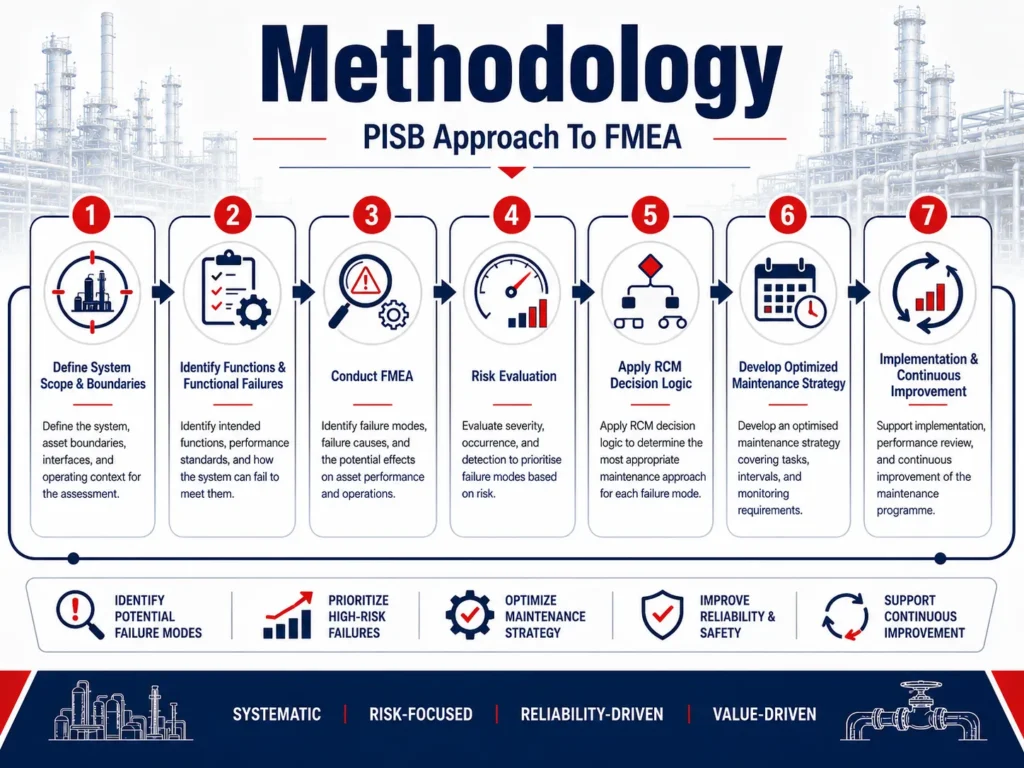
Failure Mode and Effect Analysis (FMEA): Our FMEA-driven approach helps optimise preventive maintenance strategies by identifying the most likely failure modes for each equipment item and tailoring inspection activities accordingly.
Our Procedure for Asset Integrity Assessment
At Pure Integrity, our asset integrity assessment procedure follows a structured, standards-aligned methodology designed to deliver practical, actionable outcomes:
Step 1: Scoping & Data Collection We begin with a detailed scoping workshop with your operations, maintenance, and engineering teams. During this phase, we review the plant’s asset register, process flow diagrams (PFDs), piping and instrumentation diagrams (P&IDs), design data packages, and historical inspection records. The goal is to establish a complete picture of your facility’s equipment inventory and operating context.
Step 2: Damage Mechanism Identification Using API 571 as the primary reference, our corrosion engineers identify the active and potential degradation mechanisms for each equipment item based on its metallurgy, process environment, and operating history. Common mechanisms in Malaysian facilities include CO₂ corrosion, naphthenic acid corrosion, high-temperature hydrogen attack, and chloride stress corrosion cracking.
Step 3: Risk Ranking & Inspection Planning Each equipment item is assessed for its probability of failure and consequence of failure following API 580/581 methodology. The output is a risk-ranked equipment list and a tailored inspection plan that specifies the inspection technique, scope, and interval for each item. Our RBI services ensure that high-risk items receive immediate attention while low-risk equipment is safely deferred.
Step 4: Inspection Execution Inspections are carried out by qualified API 510/570 certified inspectors using appropriate NDT techniques. We coordinate with your turnaround planning team to maximise inspection coverage during available windows while minimising production disruption.
Step 5: Analysis, Reporting & Action Plan Inspection results are analysed against acceptance criteria defined by ASME, API, and PTS requirements. Where findings exceed allowable limits, FFS assessments are conducted per API 579. The final deliverable is a comprehensive integrity assessment report with a prioritised action plan, cost estimates, and timeline recommendations.
Step 6: Continuous Monitoring & Review Asset integrity assessment is not a one-time exercise. We help clients establish ongoing monitoring programmes, including integrity operating windows (IOWs), corrosion rate trending, and periodic RBI updates, to ensure that risk profiles remain current and inspection plans evolve with changing conditions.
Expert Commentary
From a process safety and integrity engineering perspective, asset integrity assessment in Malaysia has entered a new era. The SSI Regulations 2025 have elevated the standard of practice, moving the industry from prescriptive, calendar-driven inspections to a more sophisticated risk-based approach that demands technical competence and data quality.
Experts recommended that Malaysian plant operators take three immediate actions. First, conduct a gap analysis of current integrity assessment practices against SSI 2025 requirements and API 580/581 guidelines. Second, invest in data consolidation, many plants have valuable inspection data locked in legacy systems that needs to be centralised and validated before meaningful risk analysis can proceed. Third, ensure that the integrity assessment team includes personnel with the right mix of competencies: API-certified inspectors, experienced corrosion engineers, and process safety professionals who understand the interaction between equipment integrity and process hazards.
The integration of asset integrity assessment with process safety management is particularly critical. Panduan DOSH dan PETRONAS suggested that mechanical integrity, one of the 14 elements of PSM, should not be managed in isolation. Equipment integrity failures can trigger loss of containment events that cascade into major accident hazards. A BowTie analysis approach can help visualise these scenarios and ensure that integrity assessment activities are aligned with the facility’s major hazard register.
For facilities considering life extension beyond original design life, the stakes are even higher. Ageing mechanisms such as creep, fatigue, and long-term metallurgical changes require specialised assessment expertise that goes beyond routine inspection. Engaging a qualified integrity consultancy early in the life extension planning process can prevent costly surprises during implementation.
When Should You Seek Professional Consultancy?
Not every facility has the in-house capability to conduct comprehensive asset integrity assessments. Here are the situations where engaging an external integrity engineering consultancy is not just advisable, it is essential:
Regulatory Compliance Deadlines: If your facility needs to demonstrate compliance with the SSI Regulations 2025, or if your Certificate of Fitness renewal is approaching and you need to transition from time-based to risk-based inspection, professional guidance can accelerate the process and avoid compliance gaps.
Ageing Assets Beyond Design Life: When equipment has been operating for 20, 30, or 40 years, well past original design assumptions, a specialist life extension assessment is critical. This is not a task for general maintenance teams; it requires expertise in metallurgy, creep assessment, fatigue analysis, and FFS methodology.
Post-Incident Investigation: Following any loss of containment event, equipment failure, or near-miss incident, an independent asset integrity assessment can identify systemic integrity issues that may have contributed to the event and prevent recurrence.
Turnaround Planning: Major turnarounds represent the best opportunity for comprehensive integrity assessment. Engaging a consultancy early in the turnaround planning phase ensures that the right inspections are scoped, the right NDT techniques are specified, and the results are properly analysed and acted upon.
Mergers, Acquisitions & Asset Transfers: When industrial assets change ownership, a baseline integrity assessment provides critical due diligence information about equipment condition, remaining life, and deferred maintenance liabilities.
New Regulatory Requirements: As Malaysia’s regulatory landscape continues to evolve, with the SSI Regulations 2025 representing just the latest milestone, staying ahead of compliance requirements is far less costly than catching up after enforcement action.
What is the difference between asset integrity assessment and a DOSH inspection?
A DOSH inspection verifies compliance with specific regulatory requirements and results in a Certificate of Fitness. An asset integrity assessment is a broader, more comprehensive evaluation that examines all degradation mechanisms, evaluates remaining life, quantifies risk using API 580/581 methodology, and develops a prioritised inspection and maintenance strategy. Think of the DOSH inspection as the minimum legal requirement, while asset integrity assessment is best engineering practice that goes well beyond compliance.
How often should asset integrity assessment be conducted for Malaysian plants?
The frequency depends on equipment risk levels. Under the SSI Regulations 2025, risk-based data must be collected and maintained at least every 12 months. However, a full asset integrity assessment, including RBI update and FFS reviews, is typically conducted every 3 to 5 years, or whenever significant process changes, equipment modifications, or inspection findings warrant reassessment. High-risk equipment may require continuous monitoring through integrity operating windows (IOWs).
What standards and codes apply to asset integrity assessment in Malaysia?
The primary framework includes the DOSH SSI Regulations 2025 for regulatory compliance, API 580/581 for risk-based inspection methodology, API 510 and 570 for pressure vessel and piping inspection, API 571 for damage mechanism identification, API 579-1/ASME FFS-1 for fitness-for-service evaluation, and ISO 55001 for the overarching asset management system. PETRONAS Technical Standards (PTS) provide additional requirements specific to the Malaysian oil and gas sector.
Can small and medium-sized plants in Malaysia benefit from asset integrity assessment?
Absolutely. While large oil and gas facilities have been early adopters of structured integrity assessment, any facility operating pressure equipment, including palm oil refineries, chemical plants, food and beverage manufacturers, and power generation facilities, can benefit. The SSI Regulations 2025 apply across all sectors regulated by DOSH. For smaller facilities, a simplified RBI approach can deliver significant value by focusing limited resources on the highest-risk equipment.
What qualifications should an asset integrity assessment team have?
A competent assessment team should include API 510/570 certified inspectors for pressure vessel and piping inspection, API 580 certified professionals for RBI methodology, ASME/API 579 competent engineers for fitness-for-service evaluation, and NDT technicians certified to ASNT or PCN standards. Additionally, having TÜV-certified functional safety engineers on the team ensures that the interaction between equipment integrity and safety instrumented systems is properly assessed. In Malaysia, registration with the Board of Engineers Malaysia (BEM) and IEM membership are additional markers of professional competence.
Conclusion
Asset integrity assessment is the foundation upon which safe, reliable, and compliant industrial operations are built. In Malaysia’s evolving regulatory landscape, shaped by the SSI Regulations 2025, PETRONAS Technical Standards, and international codes like API 580/581 and ISO 55001.
A structured approach to integrity assessment is no longer a luxury. It is a non-negotiable requirement for every plant operator who takes safety and operational excellence seriously.
The choice is clear: invest in proactive asset integrity assessment today, or pay significantly more for reactive repairs, unplanned shutdowns, and regulatory penalties tomorrow. Whether your facility is dealing with ageing infrastructure, planning a turnaround, or navigating new compliance requirements, the right integrity engineering partner can make the difference between guesswork and confidence.
At Pure Integrity, we bring field-tested expertise, certified professionals, and a deep understanding of Malaysian regulatory requirements to every asset integrity assessment engagement. If you are looking to strengthen your facility’s integrity programme, reduce operational risk, and ensure long-term compliance, we are here to help.
Reach out to our team for a consultation, because the integrity of your assets should never be left to chance.
References
- PETRONAS, “PETRONAS and DOSH Mark Regulatory Milestone with Launch of SSI Regulations 2025,” 12-August-2025. Akses: https://www.petronas.com/media/media-releases/petronas-and-dosh-mark-regulatory-milestone-launch-ssi-regulations-2025
- ISO, “ISO 55001:2024 , Asset management , Management systems , Requirements.” Akses: https://www.iso.org/standard/83054.html
- American Petroleum Institute (API), “API 580 Risk Based Inspection Certification.” Akses: https://www.api.org/products-and-services/individual-certification-programs/certifications/api580
- Inspectioneering, “API RP 581 – Risk Based Inspection Technology.” Akses: https://inspectioneering.com/tag/api+rp+581
- Mohamed, M. (2018), “Implementing risk-based inspection approach: Is it beneficial for pressure equipment in Malaysia industries?” Process Safety Progress, Wiley. Akses: https://aiche.onlinelibrary.wiley.com/doi/abs/10.1002/prs.11903
- Journal of Engineering Research and Reports, “A Case Study of Asset Integrity and Process Safety Management of Major Oil and Gas Companies in Malaysia,” 2021. Akses: https://doi.org/10.9734/jerr/2021/v20i217260
- DOSH Malaysia, “Guidelines on Occupational Safety and Health Management Systems.” Akses: https://dosh.gov.my/wp-content/uploads/2024/10/Garis-Panduan-bagi-Sistem-Pengurusan-Keselamatan-dan-Kesihatan-Pekerjaan-OSHMS.pdf
This article had been reviewed by :
Dr. Khairil Osman – He is a TUV Certified Functional Safety Engineer, a graduate of the University of Southampton, and serves as the Operation Director at Pure Integrity.