
When equipment fails in a high-hazard facility, the immediate priority is restoration – get the plant back online, minimise downtime, and manage the consequences. But without understanding why the failure happened, the same failure will happen again.
Root Cause Analysis (RCA) is the disciplined process of identifying the fundamental causes of an incident or failure – not just the immediate trigger, but the underlying conditions, systemic weaknesses, and latent failures that allowed the event to occur.

What Is Root Cause Analysis?
Root Cause Analysis is a structured investigation methodology used across the process, manufacturing, and engineering industries to determine why an incident, failure, or near-miss occurred, and to identify the corrective actions required to prevent recurrence.
The distinction between an immediate cause and a root cause is critical. An immediate cause describes what happened – a valve failed, a pipe ruptured, an instrument gave a false reading. A root cause describes why it happened – inadequate maintenance intervals, design pressure not updated following process changes, instrument not calibrated to the correct range. Without reaching the root cause, corrective actions address symptoms rather than the system.
A well-executed RCA answers three questions: What happened? Why did it happen? And what must change to prevent it from happening again?
RCA Methods in Process Safety Practice
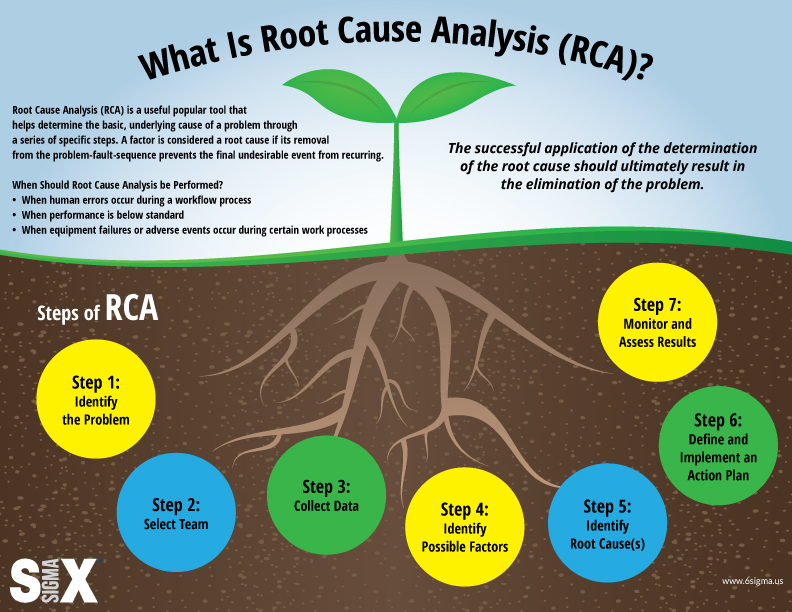
Several structured methodologies are used in process safety RCA, each suited to different incident types and levels of complexity.
The 5 Whys technique is the most widely applied for straightforward failures. By repeatedly asking “why” until the root cause is reached, it drives investigation beyond the surface. The technique is simple, fast, and effective for single-cause failures, but has limitations when multiple contributing factors are involved.
Fault Tree Analysis (FTA) takes a top-down deductive approach – starting with the undesired event and working backwards to identify the combinations of failures that could cause it. FTA is particularly valuable in complex systems where multiple simultaneous conditions must align for an incident to occur.
TRIPOD Beta is a systems-based methodology developed specifically for the process and oil and gas industries. It distinguishes between active failures (the immediate acts or errors that triggered the event) and latent conditions (the underlying organisational and management factors that created the environment for failure). TRIPOD Beta is the method of choice for complex or serious incidents where systemic causes must be identified and addressed.
RCA and the PSM Framework
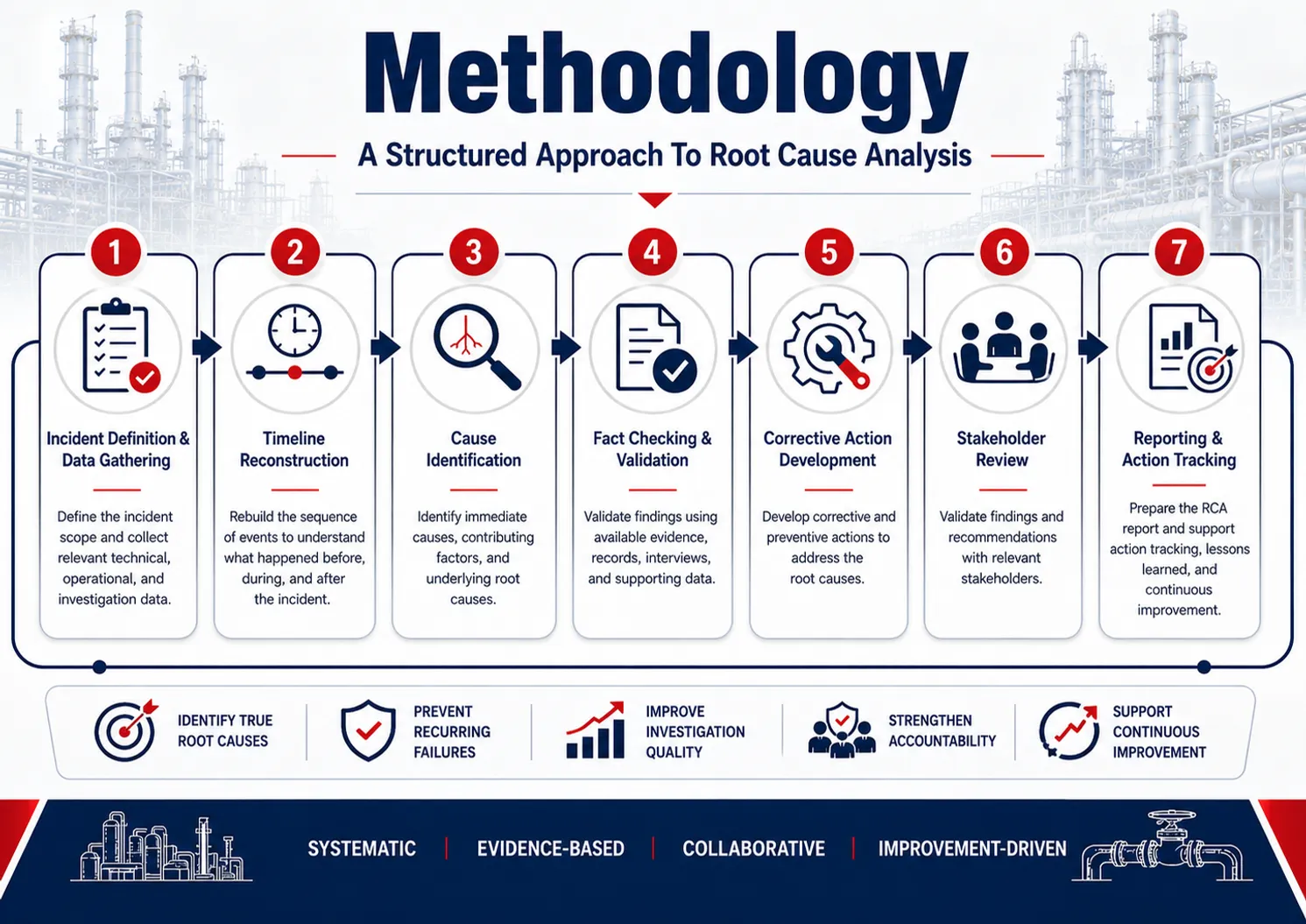
Root Cause Analysis is a key part of the element of Process Safety Management (PSM). The Incident Investigation element of PSM requires that every process safety incident – and every near-miss – is investigated to root cause, with corrective actions tracked through to completion.
The findings from RCA directly feed other PSM elements. A root cause linked to inadequate operating procedures triggers a Procedure Quality Review. A root cause linked to inadequate inspection or monitoring feeds into the Risk-Based Inspection programme under Mechanical Integrity. A root cause linked to a Management of Change failure triggers a review of the MOC process itself.
This is how RCA creates systemic improvement rather than isolated fixes. For Asset Integrity Management programmes, RCA findings are also a driver of inspection strategy updates, maintenance interval adjustments, and corrosion management improvements.
The Human Element in Root Cause Analysis
Engineering failures rarely occur in isolation. Behind most equipment failures lies a chain of human decisions – about design, maintenance, inspection, and operation – made over months or years before the incident itself.
Fasyan Sabri, P.Eng, ACPE, TUV FSE, Head of Technical Services at Pure Integrity, knows this firsthand. Over his time at SHELL and BASF Petronas Chemicals, he has facilitated numerous RCAs, getting to the root causes behind major plant outages, HSE incidents, and reliability issues. Each RCA reinforced the same lesson: to be effective, root cause analysis has to go beyond the immediate trigger and examine the organisational conditions that allowed the failure to happen in the first place.
How Pure Integrity Can Help
At Pure Integrity Sdn. Bhd., we conduct Root Cause Analysis investigations using structured methodologies including Causal Learning, Fault Tree Analysis (FTA), and 5 Whys – tailored to the complexity of the incident and the needs of the client. Our consultants bring direct operational experience in the oil and gas, petrochemical, and power generation sectors, ensuring that RCA findings are practical, defensible, and actionable.
Our RCA services are integrated with our broader process safety offering, including HAZOP and HAZID studies, ALARP Assessment, and PSM support across Malaysia and Southeast Asia.
To discuss your Root Cause Analysis requirements, contact us at https://pureintegrity.co/contact-us/
References :
1. Wiley, Root Cause Failure Analysis: A Guide to Improve Plant Reliability. Akses: https://www.wiley.com/en-us/Root+Cause+Failure+Analysis%3A+A+Guide+to+Improve+Plant+Reliability-p-9781119615613
2. ScienceDirect (Elsevier), Root Cause Diagnosis in Process Industry via Bayesian Network, 17-Apr-2025. Akses: https://www.sciencedirect.com/science/article/abs/pii/S0009250925005068
3. IChemE, Process Safety Incident Investigation Guidelines, IChemE Safety Centre. Akses: https://www.icheme.org/knowledge/process-safety/
—
Published by Pure Integrity Sdn. Bhd. – Process Safety and Functional Safety Consultants, Malaysia.
Image source: https://www.ir.com/guides/breaking-down-root-cause-analysis
https://www.6sigma.us/six-sigma-articles/what-is-root-cause-analysis-rca/