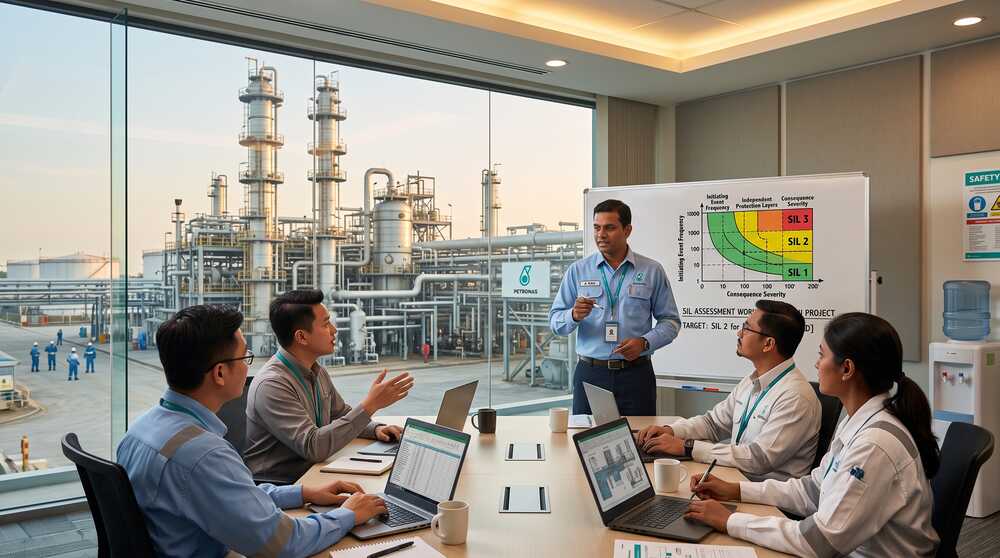
In the process industry, automated safety systems are the last line of engineered defence between a process deviation and a catastrophic event. When a pressure vessel approaches its limit, when a toxic gas is detected, when a temperature exceeds its safe operating range – it is the Safety Instrumented System (SIS) that acts. Functional Safety is the discipline that ensures those systems work when they are needed.
IEC 61511 is the internationally recognised standard that defines how Functional Safety must be achieved in the process industry. For engineers working in oil and gas, petrochemicals, refining, and power generation, understanding its key concepts is not optional – it is fundamental to safe and compliant operations.

What Is Functional Safety?
Functional Safety is the part of the overall safety of a system that depends on the correct functioning of safety-related systems – specifically, systems that respond automatically to process deviations to bring a facility to a safe state or prevent an unsafe condition from developing.
The term distinguishes safety that is achieved through automated instrumented action from safety achieved through inherent design (inherent safety) or through procedural controls (administrative safety). Functional Safety addresses the question: when the safety instrumented function is demanded, will it perform correctly?
The answer to that question is expressed in terms of a Safety Integrity Level (SIL) – a discrete measure of the reliability of a Safety Instrumented Function (SIF). IEC 61511 defines four SIL levels (SIL 1 through SIL 4), each corresponding to a specific range of probability of failure on demand. The higher the SIL, the more reliable the function must be.
The IEC 61511 Lifecycle
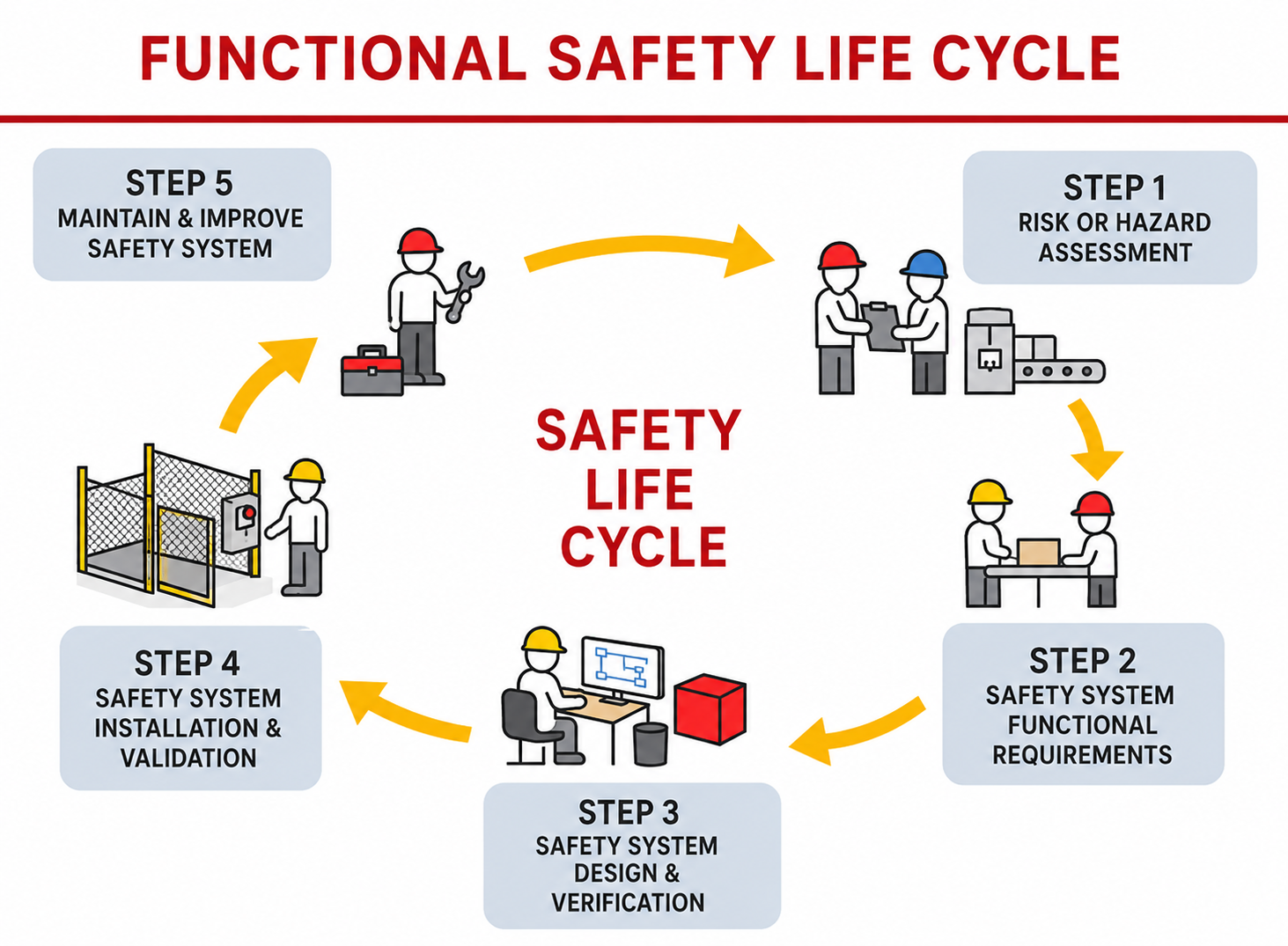
IEC 61511 is a lifecycle standard – it follows the Safety Instrumented System from its initial conception through to eventual decommissioning. The lifecycle is structured around three phases.
The first phase is the Analysis phase, which begins with hazard and risk assessment – typically conducted through HAZOP and HAZID studies and formalised through Layer of Protection Analysis (LOPA) or ALARP Assessment. The output of this phase is the Safety Requirement Specification (SRS), which defines the required SIL for each SIF based on the risk reduction needed.
The second phase is the Realisation phase, which covers the engineering, design, procurement, installation, commissioning and validation of the SIS. This phase verifies that the selected hardware and software architecture can achieve the required SIL and that all design requirements from the SRS have been met.
The third phase is the Operations and Maintenance phase, which addresses how the SIS is managed throughout its operational life – including proof testing, management of bypass and override, and management of changes that could affect SIS performance.
Key Concepts Every Engineer Must Understand

SIL Determination establishes the required SIL for each SIF based on the consequence severity, the demand frequency, and the risk reduction provided by other independent protection layers. This is typically done using LOPA or risk graph methods, following the hazard and risk analysis which identifies major accident hazard scenarios.
SIL Verification confirms that the designed SIS can actually achieve the required SIL, based on the failure rate data of the selected sensors, logic solvers, and final elements. Verification is a mathematical exercise requiring quantitative reliability data and documented calculation methodology.
Safety Requirement Specification (SRS) is the foundational document of the SIS lifecycle. It defines what each SIF must do, under what conditions, within what response time, and to what SIL. Every subsequent design, verification, and validation decision traces back to the SRS.
Proof Testing is the periodic functional testing of the SIS to confirm that it will perform correctly on demand. The frequency of proof testing is a key variable in the SIL verification calculation – longer intervals result in higher PFDavg and may cause the SIF to fall below its required SIL.
Functional Safety Assessment (FSA) is the independent review of the SIS against IEC 61511 requirements, conducted at defined stages of the lifecycle. FSA provides assurance to operators, regulators, and insurers that Functional Safety obligations have been met.
The Human Element in Functional Safety
IEC 61511 is a technically demanding standard. Its correct application requires not only theoretical knowledge but operational experience – an understanding of how SIS components behave in service, how proof testing is conducted under real plant conditions, and how management of change affects SIS integrity over time.
Fasyan Sabri, P.Eng, ACPE, TUV FSE, Head of Technical Services at Pure Integrity, is TUV Rheinland certified in Functional Safety Engineering and brings hands-on field experience from major operators such as SHELL and BASF-PETRONAS. Having led instrumentation and control teams and served as Technical Assurance (TA) for plant Safety Instrumented Systems, he has firsthand insight into what it takes to keep an SIS running at the highest standard while remaining sustainable. He has also facilitated HAZOP and SIL classification workshops and conducted FSAs for major projects around the world. That operational perspective shapes how Pure Integrity approaches Functional Safety work: rigorously aligned with IEC 61511, and grounded in the realities of field implementation.
How Pure Integrity Can Help
At Pure Integrity Sdn. Bhd., we provide a full scope of Functional Safety services aligned with IEC 61511, including SIL Determination, SIL Verification, Safety Requirement Specification development, and Functional Safety Assessment (FSA). Our Functional Safety work is fully integrated with our Process Safety Management, HAZOP, LOPA, and Asset Integrity Management services.
To discuss your Functional Safety requirements, contact us at https://pureintegrity.co/contact-us/
References :
1. Goble WM, IEC 61511 and the Capital Project Process – A Protective Management System Approach, ScienceDirect (Elsevier), 2005. Akses: https://www.sciencedirect.com/science/article/abs/pii/S030438940500422X
2. Gruhn P, IEC 61511 – Functional Safety in the Process Industry: The Prominence of Validation and Verification, CSIRO Publishing, 2015. Akses: https://www.publish.csiro.au/aj/aj14031
3. IChemE, Functional Safety and Safety Instrumented Systems – Technical Guidance. Akses: https://www.icheme.org/knowledge/process-safety/
—
Published by Pure Integrity Sdn. Bhd. – Process Safety and Functional Safety Consultants, Malaysia.