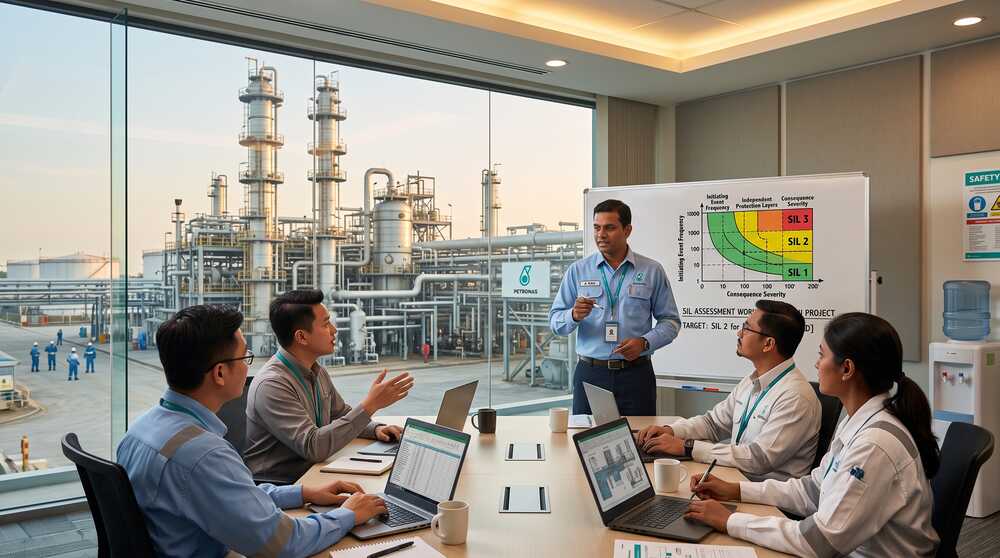
A Safety Instrumented System is designed to act at the moment of a process demand. But between demands – which may be months or years apart – its actual condition is largely invisible. Are the sensors drifting? Has a valve partially seized? Is the logic configuration still aligned with the current Safety Requirement Specification? In a traditional functional safety environment, these questions can only be answered by proof testing. By definition, that means some period of undetected degradation is accepted as normal.
Digital Functional Safety changes this. By connecting field devices, logic solvers, and safety management data into an integrated digital environment, it makes the real-time condition of every safety-critical component visible – continuously, not just at test intervals.

What Is Digital Functional Safety?
Digital Functional Safety is the application of digital technologies – including smart field devices, digital twin models, continuous diagnostics, and integrated safety management platforms – to the management of Safety Instrumented Systems throughout their operational lifecycle.
The objective is not to replace IEC 61511 but to implement it more rigorously. IEC 61511 already requires that SIS performance be monitored, that proof test results be recorded, that changes be managed, and that the achieved SIL be maintained throughout the operational phase. Digital tools make it operationally feasible to meet these requirements at scale.
Field Intelligence: From Periodic to Continuous

Traditional proof testing schedules are derived from SIL verification calculations – the test interval is set such that the average probability of failure on demand remains within the acceptable range. This is a sound approach, but it relies on an assumption: that the device remains in its design condition between tests.
Smart field devices challenge this assumption. Modern HART-enabled transmitters, smart valve positioners, and digital pressure switches continuously report their own diagnostic status – detecting drift, sensor fouling, valve hysteresis, and partial failures that would not be visible during a periodic test. This diagnostic information, when properly integrated into the safety management system, enables condition-based proof testing rather than calendar-based testing.
This is the practical application of Alarm Management principles to the SIS environment: making the right information available to the right people at the right time, so that critical conditions are not buried in a flood of low-priority alerts.
Digital Safety Management Platforms

Beyond individual device diagnostics, digital Functional Safety platforms integrate the entire safety lifecycle into a connected data environment. Safety Requirement Specifications, SIL verification calculations, proof test records, bypass logs, and management of change documentation are linked to individual SIF records – creating a living safety case that reflects the actual current state of the SIS rather than its state at commissioning.
This integration matters for Process Safety Management compliance. The Mechanical Integrity element of PSM requires documented evidence that safety-critical systems are maintained to their design standard. Digital platforms make it possible to demonstrate this continuously.
For Asset Integrity Management programmes, the integration of SIS data with wider asset management systems enables corrosion monitoring, inspection scheduling, and reliability analysis with full visibility of the safety function implications of any identified degradation.
Digital Tools and the IEC 61511 Lifecycle
IEC 61511 does not prescribe digital tools, but many of its requirements are most efficiently met through digital means. The SIL verification requirement – that PFDavg be calculated and demonstrated to remain within acceptable bounds throughout the operational lifecycle – is significantly more tractable when proof test data is captured digitally and automatically factored into ongoing calculations.
The management of change requirement – that any modification to the SIS be assessed for its impact on the achieved SIL before implementation – is far more robust when all change records, current SRS documentation, and SIL verification calculations are held in an integrated platform.
The Human Element in Digital Functional Safety
Technology without engineering judgment is data without insight. The value of digital Functional Safety tools depends entirely on the competence of the engineers who interpret their outputs, maintain their data, and act on their findings.
Fasyan Sabri, P.Eng, ACPE, TUV FSE, Head of Technical Services at Pure Integrity, brings the combination of TUV-certified functional safety expertise and direct field experience that digital tools require to be effective. His experience managing instrument systems through a major turnaround at a Port Dickson refinery in 2015 – where the gap between design documentation and field reality was directly encountered – shapes how Pure Integrity approaches digital safety work.
“Stay hungry to learn, remain humble in receiving lessons from those with experience.”
How Pure Integrity Can Help
At Pure Integrity Sdn. Bhd., we support clients in integrating digital tools into their functional safety programmes, from smart device commissioning and diagnostic configuration through to IEC 61511-aligned proof test procedure development.
Our services span the full functional safety lifecycle, including SIL Determination, SIL Verification, Functional Safety Assessment, and HAZOP and HAZID studies, delivered by TUV-certified consultants across Malaysia and Southeast Asia.
To discuss your Digital Functional Safety requirements, contact us at https://pureintegrity.co/contact-us/
References :
1. Gruhn P, IEC 61511 – Functional Safety in the Process Industry: The Prominence of Validation and Verification, CSIRO Publishing, 2015. Akses: https://www.publish.csiro.au/aj/aj14031
2. ScienceDirect (Elsevier), IEC 61511 and the Capital Project Process – A Protective Management System Approach, 2005. Akses: https://www.sciencedirect.com/science/article/abs/pii/S030438940500422X
3. IChemE, Digital Safety and Industry 4.0 – Process Safety Implications, IChemE Safety Centre. Akses: https://www.icheme.org/knowledge/process-safety/
—
Published by Pure Integrity Sdn. Bhd. – Process Safety and Functional Safety Consultants, Malaysia.
Image source: https://www.tuv.com