
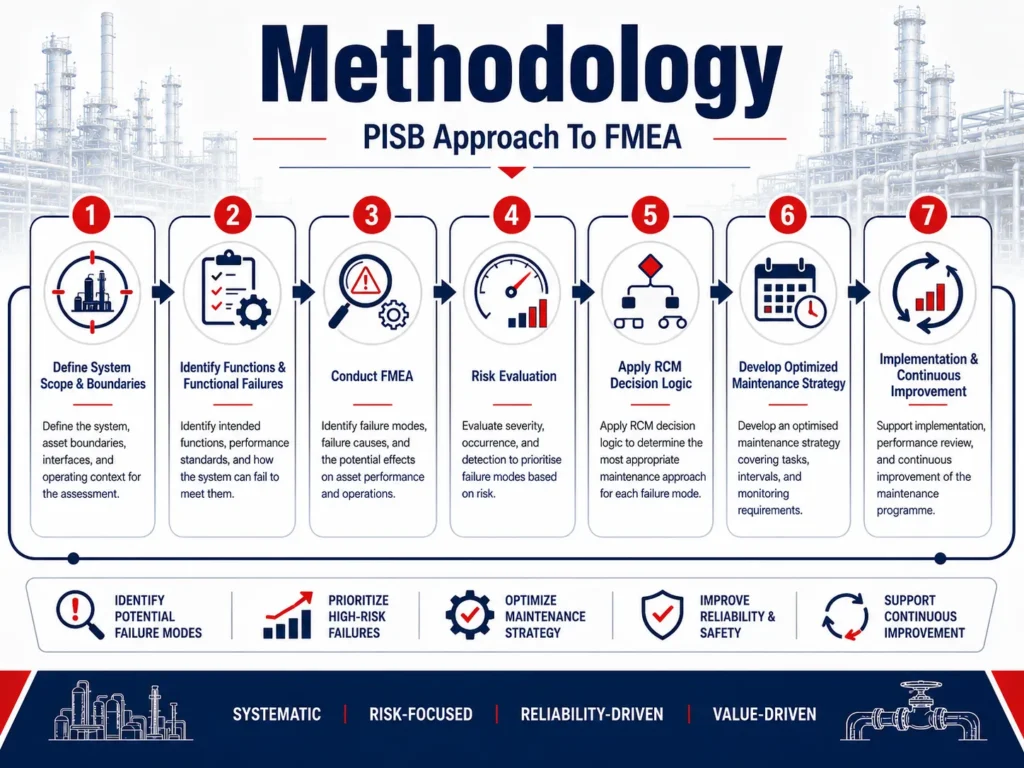
Preventive maintenance programmes are only as effective as the thinking that went into designing them. A maintenance schedule built on manufacturer recommendations, calendar intervals, or historical convention may keep equipment running – but it will not necessarily target the failure modes that matter most.
Failure Mode and Effect Analysis (FMEA) provides the structured foundation that preventive maintenance programmes too often lack. By systematically identifying how each component or system can fail, what the consequence of that failure would be, and how detectable it is before it occurs, FMEA enables organisations to direct maintenance resources precisely where the risk is highest.
What Is Failure Mode and Effect Analysis?
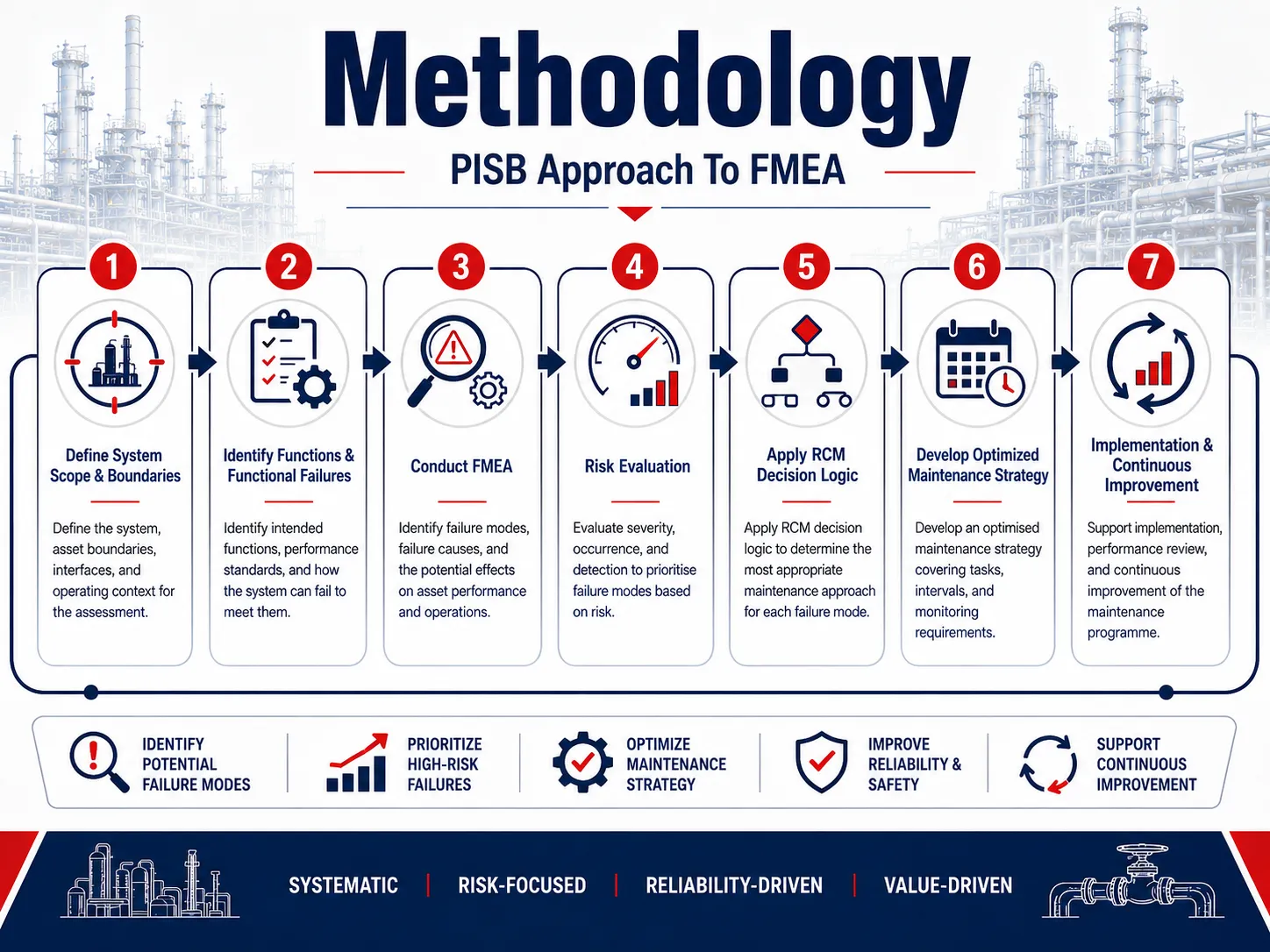
Failure Mode and Effect Analysis is a structured, bottom-up reliability methodology that examines every element of a system or process to identify potential failure modes, their causes, their effects on the system, and the controls that are currently in place.
Each failure mode is assessed using three dimensions: Severity (S) – how serious is the consequence of the failure? Occurrence (O) – how frequently is the failure mode likely to occur? Detection (D) – how likely is it that the failure will be detected before it causes harm? These three scores are multiplied to produce a Risk Priority Number (RPN), which ranks failure modes by relative risk and drives prioritisation of maintenance interventions.
Originally developed in aerospace, FMEA has been widely adopted across the process, oil and gas, petrochemical, and power generation industries – wherever asset reliability and process safety intersect.
FMEA in Preventive Maintenance Design

The application of FMEA to preventive maintenance transforms a maintenance programme from a schedule into a risk-based strategy. Rather than maintaining everything at the same frequency, FMEA-driven maintenance concentrates effort on the failure modes with the highest RPN – those that are severe, frequent, or difficult to detect before causing harm.
For each high-priority failure mode identified, the FMEA output defines the appropriate maintenance task: condition monitoring, periodic inspection, functional testing, replacement at a fixed interval, or redesign to eliminate the failure mode altogether. This is the foundation of a Reliability-Centred Maintenance (RCM) approach, in which maintenance decisions are anchored to failure mode analysis rather than convention.
In the context of Asset Integrity Management, FMEA is a critical input to inspection and maintenance planning. It identifies which equipment items carry the highest failure risk, what the failure mechanisms are, and what inspection or testing strategy is required to manage those mechanisms effectively – directly complementing Risk-Based Inspection programmes.
FMEA and Process Safety

FMEA is not only a maintenance tool – it is a process safety tool. When applied to safety-critical equipment, including pressure relief devices, emergency shutdown systems, and fire and gas detection systems, FMEA provides a structured basis for demonstrating that failure modes have been identified and that adequate preventive measures are in place.
For Safety Instrumented Systems (SIS) governed by IEC 61511, FMEA contributes to the hardware safety assessment by identifying failure modes that could cause a Safety Instrumented Function (SIF) to fail on demand. This feeds directly into the SIL verification process and ensures that the achieved SIL reflects the actual failure behaviour of the selected components.
The connection between FMEA and Process Safety Management is explicit: the Mechanical Integrity element of PSM requires that failure modes of critical equipment be understood and managed through appropriate inspection and maintenance strategies. FMEA provides the analytical basis for meeting this requirement.
The Human Element in FMEA
An FMEA is only as complete as the knowledge brought into it. The most thorough analysis can miss critical failure modes if the team conducting it lacks direct operational experience with the equipment under review.
Fasyan Sabri, P.Eng, ACPE, TUV FSE, Head of Technical Services at Pure Integrity, brings that experience. Having led the Instrument Department through a major turnaround at a Port Dickson refinery in 2015, he has encountered failure modes that appear only under specific operational conditions – failure modes that a desk-based analysis might overlook but that experienced field engineers recognise immediately.
“Stay hungry to learn, remain humble in receiving lessons from those with experience.”
How Pure Integrity Can Help
At Pure Integrity Sdn. Bhd., we conduct FMEA studies as part of our asset integrity and process safety service offering. Our team brings the technical depth and field experience to ensure that FMEA outputs are accurate, practically relevant, and directly actionable within your maintenance programme.
Our services also include HAZOP and HAZID studies, Root Cause Analysis, SIL Assessment, and Functional Safety Assessment – across oil and gas, petrochemical, and power generation sectors in Malaysia and Southeast Asia.
To discuss your Failure Mode and Effect Analysis requirements, contact us at https://pureintegrity.co/contact-us/
References :
1. Alamri TO & Mo JPT, Failure Mode Structured Preventive Maintenance Scheduling With Changing Failure Rates in Industry 4.0 Environment, Frontiers in Manufacturing Technology, 17-Feb-2022. Akses: https://www.frontiersin.org/journals/manufacturing-technology/articles/10.3389/fmtec.2022.828986/full
2. ScienceDirect (Elsevier), Data-Driven Failure Mode and Effect Analysis (FMEA) to Enhance Maintenance Planning, 03-Apr-2021. Akses: https://www.sciencedirect.com/science/article/abs/pii/S0166361521000580
3. IChemE, Process Equipment Reliability and Maintenance – Safety Centre Guidance. Akses: https://www.icheme.org/knowledge/process-safety/
—
Published by Pure Integrity Sdn. Bhd. – Process Safety and Functional Safety Consultants, Malaysia.
Source: https://www.emaint.com/blog/what-is-fmea-failure-mode-and-effects-analysis/


