Turn complex major-accident risk into one clear picture your board & your operators both understand threats, top event, consequences & every barrier in between, with an owner against each one.
Your team workssafer and more efficiently with manuals they can actually understand.
Identify
Analyze
Evaluate
Recommend
Verify
What is bow-tie analysis?
A bow-tie is a single diagram that maps a major-accident scenario from end to end. At the centre is the top event typically a loss of containment. On the left are the threats that could cause it and the prevention barriers that stop them; on the right are the consequences and the mitigation barriers that limit them. Escalation factors show what could defeat a barrier, with their own barriers in turn. The shape — threats and consequences fanning out from a central knot gives the method its name, and its power: it makes risk, and the safeguards you’re relying on, visible at a glance. It’s the practical, communicable form of the “Swiss cheese” model of layered defences.
Your analysis is only useful if leadership can act on it
HAZOP worksheets and QRA tables are essential — but no executive reads them, and no operator carries them into the field. That’s a real risk: the people who fund barriers and the people who maintain them can’t see what they’re responsible for.
A bow-tie closes that gap. It translates your studies into one page that answers the question leadership actually asks what is protecting us, and where are the gaps? and it assigns each barrier an owner and a performance standard. That’s how a bow-tie pays back: it turns abstract major-accident risk into specific, owned, maintainable controls, demonstrates ALARP to DOSH and your board, and stops “safety critical” equipment from quietly degrading because no one was accountable for it
Our bow-tie services
Bow-tie workshop facilitation
We build the diagrams with your team for your highest major-accident hazard scenarios.
Barrier / Safety Critical Element (SCE) identification
Defining which barriers genuinely matter and what “good” looks like for each.
Barrier health & assurance
Checking each barrier is present, sufficient and maintained, with performance standards and owners not just drawn on a chart.
FAQ
How is a bow-tie different from a HAZOP?
A HAZOP systematically finds hazards in detail a bow-tie takes a selected major-accident scenario and shows, on one diagram, the barriers preventing and mitigating it. They complement each other HAZOP feeds the bow-tie.
Is bow-tie analysis required by DOSH?
It isn't mandated as a specific deliverable, but it's a widely recognised, powerful way to demonstrate that your major-accident barriers are identified, owned and maintained — which supports your CIMAH and PSM obligations and your ALARP case.
What are prevention and mitigation barriers?
Prevention barriers stop a threat from causing the top event (e.g. a trip system) mitigation barriers limit the consequences after it occurs (e.g. fire suppression, emergency response).
Can a bow-tie drive barrier ownership and maintenance?
Yes — that's its biggest strength. Each barrier gets an owner & a performance standard, turning a one-off study into a living management tool.
How many bow-ties does a site need?
Usually one per major-accident hazard scenario — most sites focus on a manageable set of their highest-consequence events, not everything.
Who We Work With
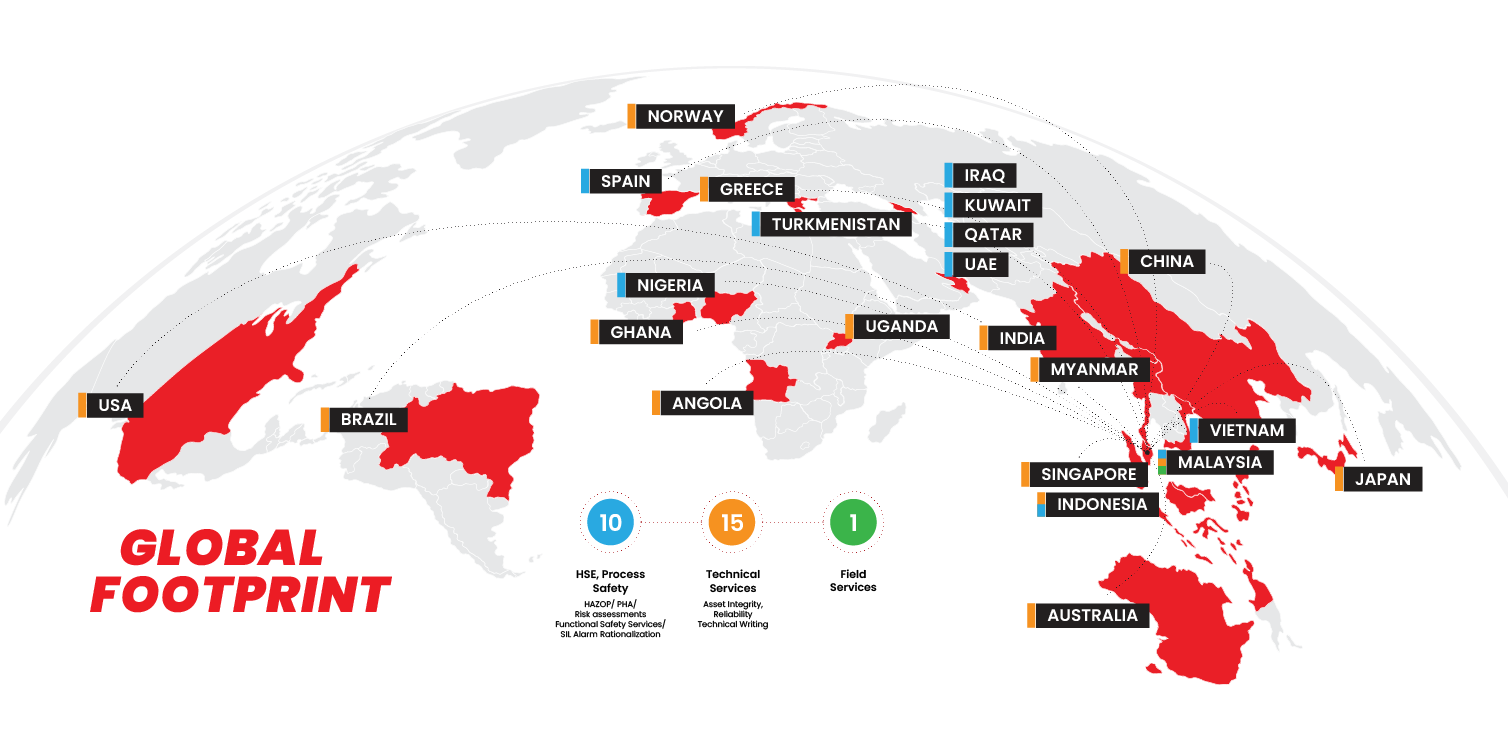
We have worked closely with many local and multi-national companies in Malaysia as well as overseas to fulfil their specific needs. Through recognised certification training, we help individuals and teams build the competency their roles and industries demand.
Can your leadership see, on one page, exactly what's protecting your plant?
Request a bow-tie workshop and make your major-accident barriers visible & accountable.