Some organization file HAZOP, LOPA, and SIL studies under the same budget category as fire extinguisher servicing: necessary, recurring, non-negotiable, and definitely not where anyone expects a return.
Then something goes wrong, and the math changes overnight.
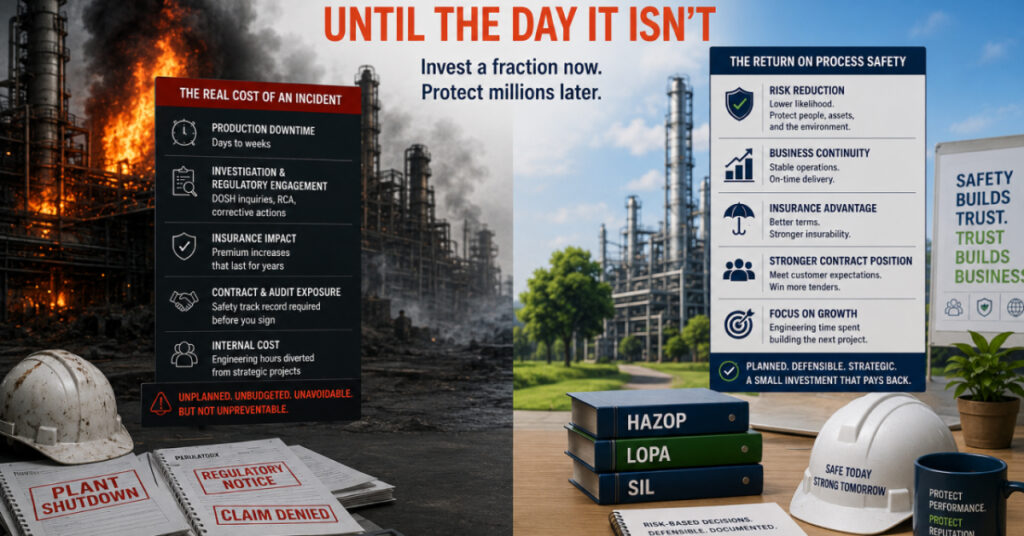
A single loss-of-containment incident doesn’t just cost the immediate cleanup. It stacks up across categories that rarely show up in the same conversation as “process safety budget”:
- Production downtime : days to weeks, depending on the unit affected
- Investigation and regulatory engagement : regulator (e.g. DOSH in Malaysia) inquiries, internal root-cause investigations, corrective action tracking
- Insurance impact : premium increases that outlast the incident itself, sometimes for years
- Contract and audit exposure : increasingly, oil & gas majors and export-focused oleochemical buyers ask for process safety track record before they sign, not after
- Internal cost : engineering hours diverted into firefighting instead of the next project
None of these line items existed in anyone’s budget forecast. They show up anyway after an incident.
Here’s the contrast we see play out, in different forms, across almost every plant we’ve worked with: the team that treats a LOPA study as a scoping exercise, “what’s the minimum we need to pass audit” .
Versus the team that treats it as a risk-reduction investment with a number attached.

The first team gets a document. The second team gets a defensible answer to “how do you know this is safe enough,” which turns out to matter a great deal more often than expected; to regulators, to insurers, and increasingly to customers running their own supply chain risk reviews.
The reframe that actually holds up under scrutiny isn’t “process safety is important“, everyone already agrees with that in principle. It’s narrower and more useful than that:
“A properly scoped HAZOP/LOPA/SIL program is usually a fraction of the cost of a single incident it prevents, and it’s one of the few line items that quietly protects your ability to continue to operate safely, reliably, and profitably.”
We’re seeing this shift in real time. Clients outside traditional oil & gas, oleochemicals, specialty chemicals, increasingly advanced manufacturing, are no longer asking us “do we legally need this.”
They’re asking; “What do our customers and external stakeholders expect to see when they audit us?“
That’s a different conversation, and it’s a better one.
If your last internal conversation about process safety budget started with “what’s the minimum required,” it might be worth reframing it around “what does this protect.“
Got questions about where your plant stands? Connect with our consultants today for :
Published on June 2026.
Source : LinkedIn