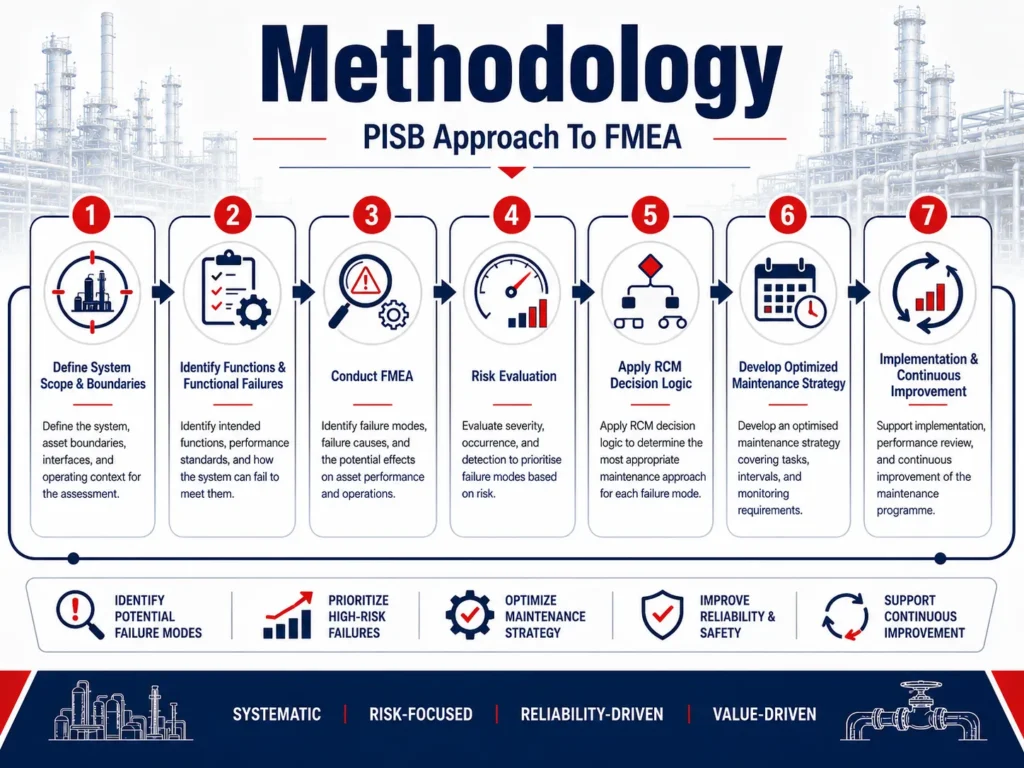

Early in my career, fixed-interval inspection was the norm. Equipment was inspected on a set schedule every year, every two years, every planned shutdown regardless of its actual condition, its service environment, or how much risk it genuinely carried. I understood why the approach existed. It was simple, auditable, and gave organisations a sense of structure. But the more time I spent in the field, the more clearly I saw its limitations.
Low-risk assets were being inspected repeatedly, consuming engineering hours and budget, while genuinely high-risk equipment sometimes received no more attention than everything else in the queue. The system was not calibrated to reality. It was calibrated to the calendar.
Risk Based Inspection or RBI is the methodology that corrects this. Today it is widely adopted in oil and gas, petrochemical processing, power generation, and heavy manufacturing, and it has fundamentally changed how the industry thinks about inspection planning. In this article I want to explain what RBI is, how it works, and why I believe it represents a more honest and effective approach to managing equipment integrity.
What is Risk Based Inspection?
Risk Based Inspection is a systematic method for prioritising inspection activities based on the risk that each asset actually carries, rather than where it sits on a maintenance calendar.
Risk is evaluated using two key components. The first is Probability of Failure the likelihood that an asset will fail due to factors such as corrosion, fatigue, erosion, or operational stress. The second is Consequence of Failure the potential impact of that failure, including safety risks, environmental damage, and production loss. Combining these two factors gives you a risk ranking that can be used to drive inspection planning decisions.
High-risk assets receive more frequent and more targeted inspection. Lower-risk assets may qualify for extended intervals not as a cost-cutting measure, but because the engineering assessment supports it. That distinction matters. RBI is not about inspecting less. It is about inspecting where the risk actually is.
The Limitations of Fixed Interval Inspection
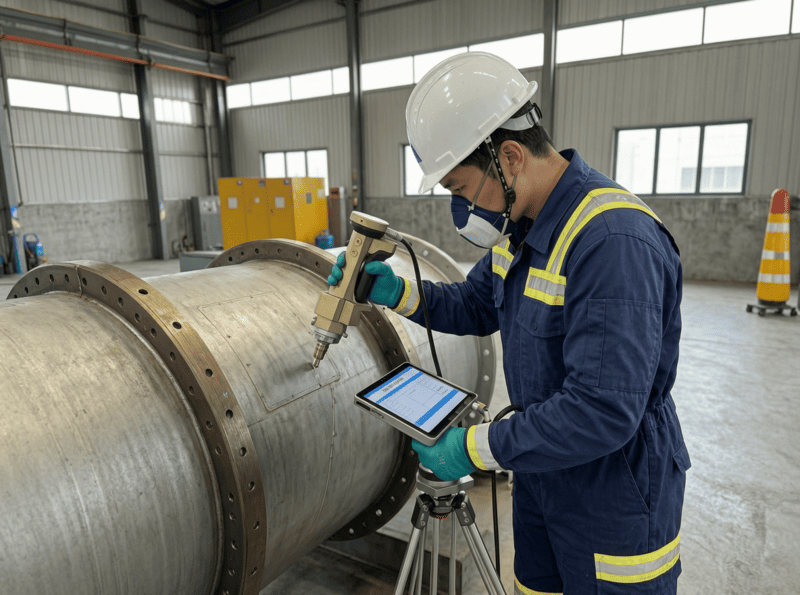
I have seen the consequences of poorly calibrated inspection programmes up close. During a major turnaround I led at a refinery in Port Dickson in 2015, my team uncovered corrosion under insulation on instrument impulse lines that had gone completely undetected during years of routine fixed-interval inspections. We also found calibration drift on critical safety instruments small enough not to trigger alarms during normal operations, but significant enough to affect performance when it mattered most.
The facility was not being negligent. It was following its inspection schedule. The problem was that the schedule was not designed around an understanding of what that specific equipment was susceptible to, under those specific service conditions. It was designed around time. And time is a poor proxy for risk.
Fixed interval inspection has several structural weaknesses that RBI directly addresses:
- Low-risk equipment may be inspected too frequently, consuming resources with limited safety benefit
- High-risk assets may not receive sufficient monitoring between scheduled intervals
- Inspection resources are spread evenly regardless of where the actual risk concentrates
- Maintenance costs rise without a corresponding improvement in safety outcomes
As industrial systems grow more complex and assets age beyond their original design life, the limitations of purely time-based inspection become more pronounced. The industry needed a better framework, and RBI provides one.
The Transition to Risk Based Maintenance
RBI is not just an inspection tool. It enables a broader shift in how organisations think about maintenance strategy. When inspection intervals are driven by risk, maintenance decisions naturally follow the same logic resources flow toward the assets and systems where the consequences of failure are highest.
This is what I call risk-based maintenance thinking: the recognition that not all equipment demands the same level of attention, and that intelligent allocation of engineering effort is both safer and more sustainable than uniform treatment across an asset population.
International standards support this approach, particularly the API Recommended Practices for RBI implementation API RP 580 and API RP 581 which provide the methodological framework most widely used in our industry. In Malaysia, alignment with PETRONAS Technical Standards is also expected for oil and gas operators, and a well-implemented RBI programme satisfies those requirements far more robustly than undocumented fixed-interval schedules.
Key Steps in RBI Implementation
1. Asset Data Collection
The quality of an RBI programme is only as good as the data that underpins it. Engineers collect information covering design specifications, operating conditions, process fluid characteristics, and historical maintenance and inspection records. Data gaps must be identified and managed they introduce uncertainty into risk assessments, which typically means conservative assumptions and higher initial risk rankings until real data closes the gap.
2. Damage Mechanism Assessment
For each asset, the credible degradation mechanisms are identified based on material of construction, service conditions, and process fluid. Corrosion, erosion, fatigue cracking, stress corrosion cracking, and thermal damage are common mechanisms in Malaysian industrial environments. Getting this right is fundamental if you misidentify the damage mechanism, your probability of failure assessment will be wrong, and your inspection plan will be designed to detect something that is not happening while missing what is.
3. Risk Evaluation
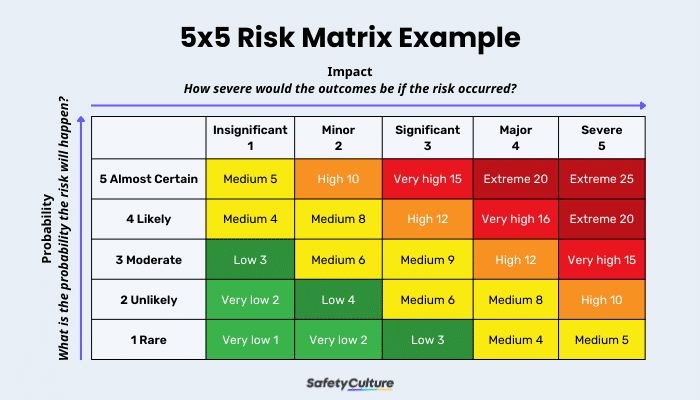
Probability and consequence of failure are assessed for each asset, producing a risk matrix that ranks the full equipment population. This ranking is what drives inspection planning decisions and allows engineers to articulate, clearly and defensibly, why different assets receive different levels of attention.
4. Inspection Planning
Inspection intervals, methods, and scope are determined based on assessed risk. High-risk assets may require enhanced non-destructive testing techniques, more frequent monitoring, or targeted inspection of specific degradation-susceptible locations. Lower-risk assets may qualify for extended intervals with appropriate justification.
5. Continuous Monitoring and Reassessment
RBI is a living programme, not a one-time study. As inspection results come in, risk assessments are updated to reflect actual degradation rates, new findings, and any changes in operating conditions. This continuous loop is what keeps the programme accurate and reliable over time.
Benefits of Risk Based Inspection
Improved Safety
High-risk assets receive the inspection intensity their risk profile demands. The likelihood of unexpected failures is reduced because degradation is detected and managed before it reaches a critical threshold.
Cost Optimisation
Inspection resources are concentrated on equipment that genuinely warrants attention. The reduction in unnecessary inspections on low-risk assets is not a safety compromise it is a logical reallocation of effort based on engineering evidence.
Better Maintenance Planning
Maintenance schedules are aligned with actual asset condition and risk rather than arbitrary timelines. This produces more predictable outcomes and reduces reactive maintenance events.
Regulatory Compliance
A well-documented RBI programme demonstrates structured risk management to regulatory bodies including DOSH and PETRONAS. It is also far more defensible in the event of an incident investigation than an undocumented fixed-schedule approach.
Industries That Use RBI
RBI is applied wherever equipment failure could carry serious safety, environmental, or operational consequences. The industries I work in most frequently oil and gas production, petrochemical and refining, power generation, chemical processing, and offshore platforms all rely on RBI to manage aging assets and ensure operational reliability. It is particularly valuable for facilities where assets are operating beyond their original design life and where the cost of unplanned failure is high.
Conclusion
The shift from fixed-interval inspection to risk-based inspection is, in my view, one of the most important advances in industrial safety management of the past few decades. It requires more rigour upfront better data, more engineering analysis, deeper understanding of degradation mechanisms but it produces fundamentally better outcomes: safer facilities, more efficient use of inspection resources, and a maintenance programme that is grounded in reality rather than convenience.
For organisations still operating on purely time-based schedules, the question worth asking is this: do you actually know where your highest integrity risks are? If the answer is anything other than a clear yes, RBI is worth serious consideration.
Reference
1. DOSH Malaysia, Occupational Safety and Health (Special Scheme of Inspection) Regulations 2025, 20-01-2025. Access: https://dosh.gov.my/wp-content/uploads/2025/01/Peraturan-Peraturan-Keselamatan-dan-Kesihatan-Pekerjaan-Skim-Pemeriksaan-Khas-2025.pdf
2. American Petroleum Institute (API), API RP 581 — Risk-Based Inspection Technology, 4th Edition, 27-02-2025. Access: https://inspectioneering.com/journal/2025-02-27/11449/api-rp-581-risk-based-inspection-technology-summary-of-changes-in-the-newly-rel
3. ISO (International Organization for Standardization), ISO 55001:2024 — Asset Management: Asset Management System — Requirements, 2024. Access: https://www.iso.org/standard/83054.html
4. TWI Global, Risk-Based Inspection and Maintenance: Industry Feedback and User Needs, Oktober-2002. Access: https://www.twi-global.com/technical-knowledge/published-papers/risk-based-inspection-and-maintenance-industry-feedback-and-user-needs-october-2002
5. Wiley / AIChE — Process Safety Progress, Implementing Risk-Based Inspection Approach: Is It Beneficial for Pressure Equipment in Malaysia Industries? (Mohamed et al.), 2018. Access: https://aiche.onlinelibrary.wiley.com/doi/10.1002/prs.11903
This article has been reviewed and validated by:
He is a TUV Certified Functional Safety Engineer who graduated from the University of Southampton and serves as Operation Director at Pure Integrity.